
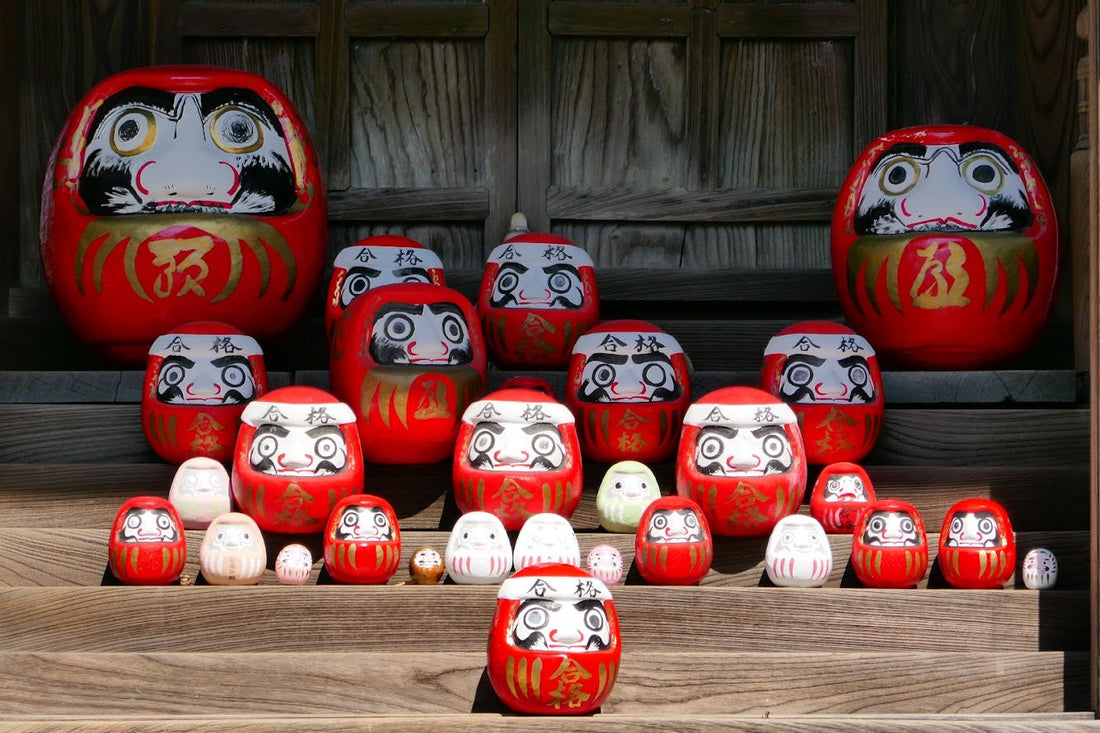
Daruma: The Secrets of a Japanese Lucky Charm
The figure that stares at you until you succeed
In the large family of slightly magical, slightly mysterious Japanese objects, there is the daruma . This small, round man, without arms or legs, who always looks a little angry—or focused, depending on the angle. He often sits on shelves, in restaurants, homes, offices… and it's not for decoration. He's there to push you to succeed.
🎓 Where does the daruma come from?
The daruma represents Bodhidharma (Daruma in Japanese), a Buddhist monk from India in the 6th century, founder of Zen . And like all great mystical figures, his legend is at once strange, extreme… and a little vague.
According to the stories, he meditated for nine whole years , either in a cave , facing a wall , or under a tree . Without speaking, without eating, without moving. Result:
👉 His arms and legs would have literally rotted away from being so still.
This is why the daruma is round, without limbs: it embodies determination to the point of forgetting oneself .
☸️ Has he achieved enlightenment?
The Zen tradition does not give a definitive answer. Some say yes, others say that asking the question is already too much .
But perhaps the real lesson is this:
The daruma is not here to enlighten you for you.
He's here to watch you until you do what you said!
👁️ Why does he often only have one eye?
The daruma is a lucky charm of determination . When you buy one, both of its eyes are white.
1. We draw a first eye while formulating a wish or a goal.
2. The daruma stares at you relentlessly until you reach your goal.
3. Once this is done, we draw the second eye , in thanks.
Basically, it's a figurine that kindly judges you until you keep your word , poko.
🖌️ What does a daruma look like?
The form is simple, but the details vary:
- It is round , to symbolize perseverance ( nanakorobi yaoki – “seven times down, eight times standing”).
- It is often red , but also exists in white, black, gold, green, etc. — each color has its meaning.
- It sometimes bears an inscription like "福" (fuku) or "幸" (sachi) for luck and happiness, or the name of the wish.
- He has big eyebrows and a stylized beard : crane- shaped eyebrows and a turtle- shaped beard — two lucky animals in Japan.
Daruma in all its forms
Traditionally made from papier-mâché in the Takasaki region, the daruma has since taken on all sorts of forms. It is found in:
- ceramics ,
- carved wood ,
- embroidered fabric ,
- and even in stylish kokeshi ! (Some kokeshi artists really like to represent Daruma in a mini-Buddha version.)
It is also printed on keychains, amulets, fans or cups... but the essence of the daruma always remains the same: to make you someone who never gives up.
Little Darumesque anecdotes
- In Japan, some politicians use a daruma during their election campaigns. They draw the first eye when they introduce themselves, and the second once they are elected. (Some remain blind in one eye for a long time.)
- There are even giant daruma that are burned during end-of-year rituals to “release wishes made.”
- Some schools or clubs offer a collective daruma to unite students around a common goal.
🎁 And at Kogedo?
At Kogedo, we love vintage daruma , sometimes patinated, sometimes very stylized, sometimes even… a little bizarre. But they all have that determined little look that makes us say:
👉 “Come on, we’re going to finish this project.”
👉 “Come on, we’ll find this print.”
👉 “Come on, we’ll post this kokeshi today.”
💬 Kogechan:
"I drew an eye for my daruma so he would remind me not to eat all the cakes during break... I never drew the second one." poko 🦝