
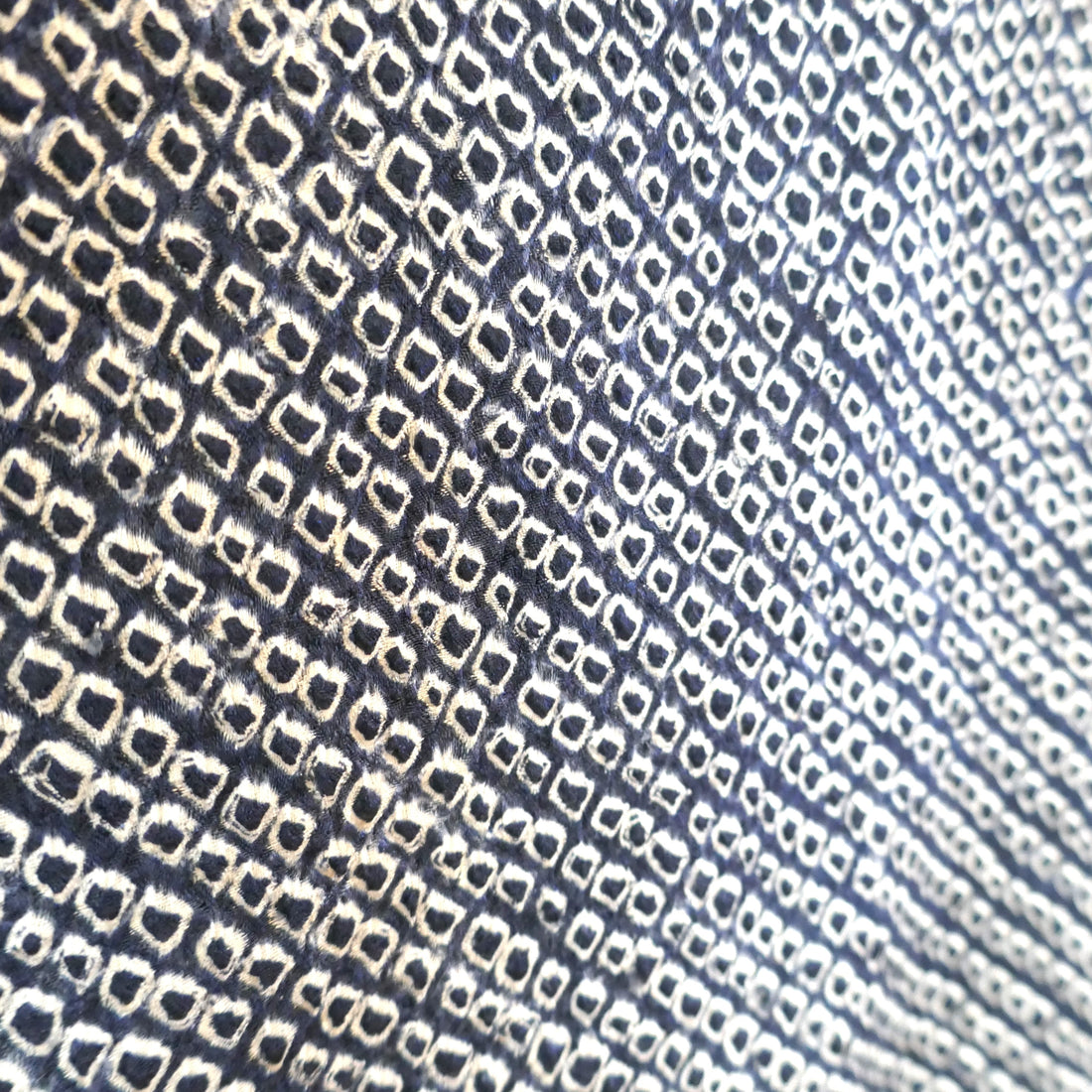
Discover the secrets of Japanese Shibori dyeing
Some fabrics speak softly, yet are unforgettable. Shibori, for its part, never shouts. It invites approach. It intrigues. It retains the trace of the hand. And sometimes, against the light, you can still see the marks of the needle…
The art of resist dyeing
Shibori (絞り) is a Japanese resist dyeing technique: certain areas of the fabric are protected before it is immersed in a dye, often indigo-based. The result? A pattern that emerges from the areas "spared" by the color. Nothing is printed, everything is manipulated.
Contrary to what one might believe, shibori is not a single technique. It is more of a family of gestures: one can fold, twist, tie, compress, sew… Each method yields a different aesthetic.
Among them, one of the most fascinating: nuishibori, or stitched shibori. Tiny regular stitches are sewn by hand into the fabric, often along long lines, before pulling on the thread to gather it. Once immersed in the dye, the fabric retains this tight shape. It is allowed to dry, then the threads are cut: the pattern is there, intact. A design of small dots or squares, always a little irregular. Always alive.
🧵 Good to know: on traditional pieces, you can often see the holes left by the needles. Discreet, but very real marks. As if the fabric has its own memory.

A matter of patience
Shibori is anything but fast. Some pieces can require entire days of preparation before even approaching a dye bath. And everything can come down to a few millimeters: the tension of the thread, the immersion time, the thickness of the fabric… No two results are identical.
This is precisely what makes its charm: each pattern is unique, impossible to reproduce identically. The opposite of industrial production. Shibori cannot be controlled. It must be respected.
A story of place

Arimatsu
If one speaks of shibori, one cannot but speak of Arimatsu, a small town located in Aichi Prefecture, near Nagoya. Since the 17th century, Arimatsu has been the great center of artisanal shibori. There, almost everything revolves around this technique: family workshops, shops, museums… One can still find artisans who practice shibori by hand, according to ancient methods.

Arimatsu
Other regions of Japan have developed their own variations, but Arimatsu remains the reference. For enthusiasts, it is a must-visit.
Why it's beautiful
Because it's a pattern that doesn't just decorate: it tells a story.
Because there is truth in these sewn stitches, in these hand-pulled pleats.
Because it is a non-smooth, imperfect, organic beauty—and therefore profoundly Japanese.
At KOGEDO, it's a pattern we adore! It's not uncommon to come across a shibori haori, unearthed at a market in Japan. If you see one, look closely: the stitches are never there by chance.