
Top 10 Stars of Japanese Prints: Hokusai, Hiroshige and Others:
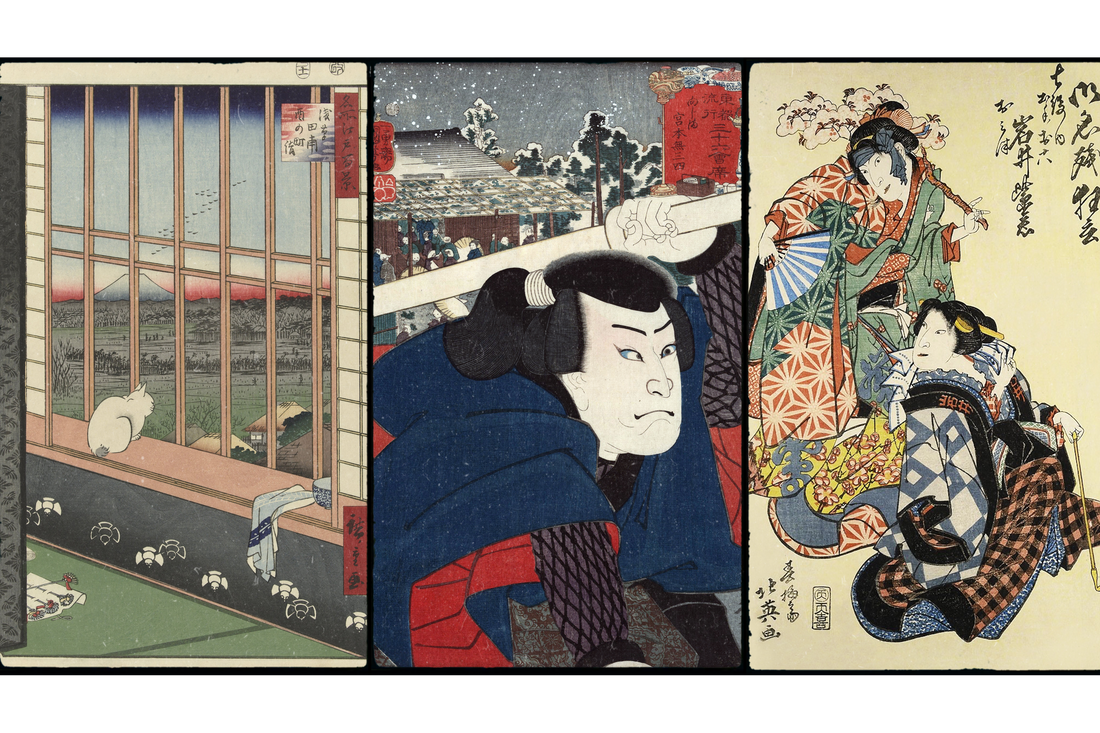
Japanese prints are a bit like cinema. There are timeless blockbusters (hello Hokusai ), contemplative masterpieces (thanks Hiroshige ), and lesser-known gems that deserve their moment in the spotlight. Today, we present our 10 favorite ukiyo-e stars , these artists who have shaped the history of this art with as much talent as brushes (and patience).
1. Katsushika Hokusai: The versatile genius
We'll start with Hokusai , because, let's be honest, he's the rock star of prints . Born in 1760 , he changed his name at least 30 times (no, it's not a joke, we'll get back to that) and created works in every genre imaginable . Landscapes, portraits, novel illustrations... Hokusai was a bit like the Leonardo Da Vinci of the Edo period .
His masterpiece: The 36 Views of Mount Fuji
His series (which actually numbers 46 , because he continued afterward) is a sublime homage to this sacred mountain . Among them, South Wind, Clear Sky (or "Red Mount Fuji") shows Fuji illuminated by the rising sun , a masterpiece of simplicity and elegance.
The essential anecdote
Hokusai is said to have said that his best work would come when he was 110. He died at 89 , but frankly, he had already set the bar high.
2. Utagawa Hiroshige: The poet of landscapes
Hiroshige , born in 1797 , is often considered one of the last great masters of ukiyo-e . Where Hokusai played with form, he preferred atmosphere . His prints are like visual haikus : soft, subtle, poetic.
His masterpiece: The 53 Stations of the Tōkaidō
He captures the road between Edo and Kyoto with infinite tenderness: travelers , merchants , light rain , evening light ... you want to buy a ticket.
The essential anecdote
He spent hours observing nature. It is even said that his rain scenes are so realistic that you can hear the drops falling. 🌧️
3. Utagawa Kunisada (Toyokuni III): The prolific portrait painter
If prints had a Top 50 , Kunisada would have been number 1 for his entire life. Born in 1786 , he is best known for his portraits of kabuki actors ( yakusha-e ), but also his bijin-ga and forays into genre scenes.
His flagship work: The Yakusha-e series
You have to see his actors on stage: dramatic expressions , swirling kimonos , you can almost hear the shamisen. A true theatre enthusiast, this Kunisada!
The essential anecdote
He is said to have signed more than 20,000 prints . Yes, that's a lot. And at Kogedo , we love to hunt for them.
4. Utagawa Kuniyoshi: The King of Imagination
If you like tattooed samurai , giant demons , and epic legends , Kuniyoshi is your man. Born in 1798 , he transformed prints into manga before their time .
His flagship work: The 108 Heroes of Suikoden
Inspired by a Chinese novel, this series is a parade of epic poses , flamboyant tattoos , and fiery looks . A major influence in the world of Japanese tattooing today.
The essential anecdote
He loved cats. And he would put them everywhere, even in his war scenes. A genius (and a real joker, poko).
5. Tōshūsai Sharaku: The shooting star of yakusha-e
Little is known about Sharaku … and that is precisely what makes him so fascinating. Active for barely ten months in 1794–1795 , he nevertheless left an indelible mark on the history of printmaking. His portraits of kabuki actors , the famous yakusha-e , are of an unprecedented intensity : exaggerated looks, accentuated wrinkles, almost disturbing emotions. Where others sought elegance, he captured the raw, unfiltered moment.
His signature work: Actors' Busts. Faces cropped in close-up, theatrical, almost caricatured expressions. It's raw, dramatic... and totally mesmerizing.
The essential anecdote We still don't know who Sharaku really was , nor why he disappeared from the scene so quickly. But this mystery, precisely, fuels the legend. Some even think that it was a kabuki actor , a group of artists or even Hokusai himself!
6. Kitagawa Utamaro: The Intimate of the Floating World
Born around 1753 , Utamaro is one of the first masters of the bijin-ga genre. He captured like no other the femininity of the Edo period : courtesans, geishas, everyday women, all drawn with grace, delicacy, and often a touch of mystery.
His flagship work: Ten Physiognomies of Women
A nuanced series that captures the subtle emotions of a glance or a gesture. It's soft, refined, and surprisingly modern.
The essential anecdote
He had some run-ins with censors after portraying a historical figure as a woman. Too ahead of his time, perhaps?
7. Kikukawa Eizan: The discreet refinement
Eizan , an indirect student of Utamaro , took up the torch of bijin-ga with a softer and more lyrical style. Born around 1787 , he painted women with a sense of graceful movement , flowing clothing , and an almost floating elegance.
His flagship work: Beauties of the Season
His women walk beneath cherry blossoms or silently close a shōji. It's simple, yet incredibly poetic.
The essential anecdote
Less exuberant than others, he has often been overshadowed. Yet, his works exude serenity and precision of line .
8. Utagawa Yoshiiku: The chronicler of his time
Born in 1833 , Yoshiiku was trained by Kuniyoshi but forged his own style, blending tradition and current events. He collaborated with newspapers, and his prints are often full of satire , social reflection , and grand dramatic scenes .
His masterpiece: The Battles of the Meiji Era
He blends ukiyo-e techniques with modern concerns. Japan is changing, and he tells the story through images.
The essential anecdote
Yoshiiku was a pioneer of journalistic printmaking , almost a graphic reporter ahead of his time. A bit like the grandfather of newspaper manga.
9. Ohara Koson: The Poet of Birds and Flowers
Active in the late Meiji period, Koson was a master of kachō-e (birds and flowers). Each print is a poem: a heron in the mist , a crane on the snow , a plum branch in the wind .
His flagship work: Birds in Winter
Sober, silent, these prints capture the fragile moment.
The essential anecdote
He spent hours observing birds to draw them. His respect for nature is evident in every feather.
10. Kawase Hasui: The Dreamer of Shin Hanga
Born in 1883 , Hasui revived printmaking in the 20th century with the shin hanga movement. He painted modern Japan, but in the ancient spirit: temples in the rain , snowy villages , evening lights ...
His masterpiece: Selected Views of Japan
Each image is a poetic postcard . The shadows, the reflections, the silence. Hasui is cinema in one image.
The essential anecdote
He traveled alone, notebook in hand, to draw on the spot. A sensitive wanderer, in search of light.
And the others…
The history of ukiyo-e does not end there. Behind these great names, there are also artists like Suzuki Harunobu , the pioneer of color, Keisai Eisen , the charmer of courtesans , or T sukioka Yoshitoshi , The last great master of printmaking. Everyone has contributed their stone (or rather, their wooden plank) to this fascinating art. We will have the opportunity to talk about it again!
Conclusion: An unparalleled legacy
The great masters of ukiyo-e transformed simple sheets of paper into timeless works. Through their prints, they told the story of Japan, sublimated its landscapes, immortalized its iconic figures, and captured moments connecting us to a bygone but still vibrant Japan. So, are you ready to embark on the floating world with your favorite print? 🌸