
What is a Japanese haori? History, style, and creations at KOGEDO
What is a haori? Haori vs. kimono?
Kogechan clears up the mystery in his column!
🧵 What is a haori?
If you thought the haori was a sort of mini-kimono to look pretty in museums, we're going to straighten out the folds right away, poko.
The haori is a traditional Japanese jacket , worn over a kimono — or today, over any everyday outfit. It is an open-front piece , with no fastening system, often equipped with discreet interior ties called himo , which can be tied up… or left loose for a more casual effect.
Its fluid drape, its straight cut, its lightness make it an incredibly modern garment , without ever needing to be.
Contrary to popular belief, the haori is neither a short kimono nor a kind of Japanese dressing gown. It has its own codes, its own look. And above all, it can go from the ryokan to the Parisian sidewalk, from the Shinto temple to your Sunday brunch , without losing a crumb of its elegance.
📜 A bit of history (I promise, it's a read without yawning)
While the haori appears to have found its glory in the Edo period, its roots go back much further , to the Heian period (8th–12th century), when the first warriors wore it over their armor. To protect yourself from the cold or rain, or to stand out. A practical, understated, no-frills garment. Pure warrior textile, poko.
But it was from the Edo period (1603–1868) that the haori left the battlefields to invite itself into daily life. Merchants, artisans and stylish urbanites gradually adopted it as outerwear. It became a utilitarian but elegant piece , often black on the outside, and sometimes richly decorated on the inside to hide the luxury and not be too conspicuous.
The female haori , on the other hand, appeared later, at the beginning of the 20th century. Less formal than the kimono, it quickly became a way for women to dress with refinement without complicating their lives . Some old pieces hide magnificent hand-painted linings , with poetic or symbolic scenes visible only to the person wearing it... or the one helping to put it on.
In short, the haori is the story of a garment that has managed to combine comfort, discretion and beauty , across eras and social classes.
✂️ How is a haori made?
Originally, these jackets were almost always sewn by hand , according to traditional kimono techniques, with very precise rules... and some liberties depending on the period and the region.
The fabrics used are often noble and solid :
-
Silk (rinzu, chirimen, tsumugi…) for luxurious and refined pieces
-
Linen or ramie for summer haori ( hitoe , unlined)
-
Wool for winter haori, thicker and warmer, often worn daily in the Showa period
-
And sometimes synthetic fibers very popular from the 1950s
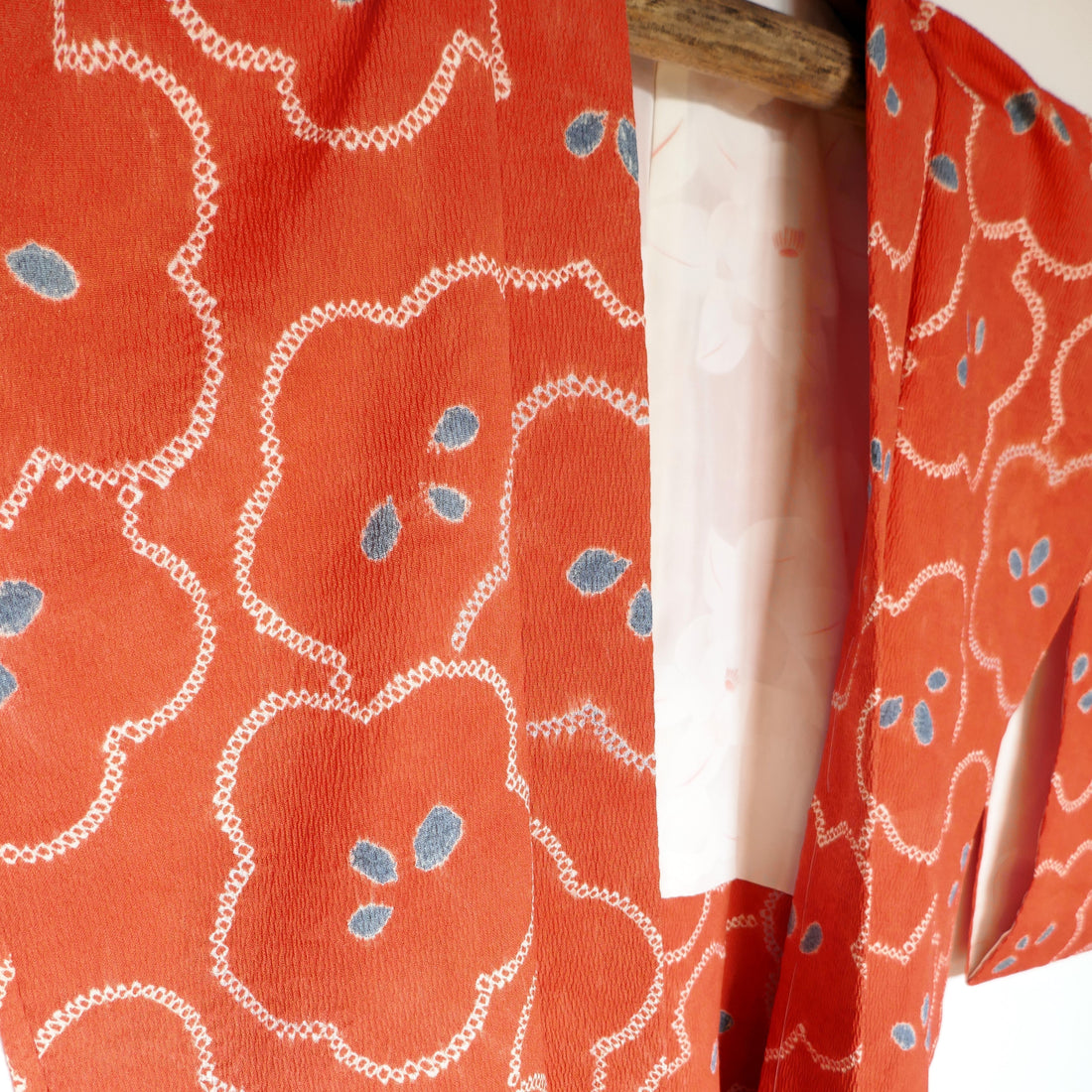
The patterns tell a story: shibori, kasuri, komon , seasonal symbols or lucky charms... each haori carries a little world in its fibers.
🧷 The different parts of a haori (anatomy of a silent chic)
-
Collar (eri) : wide, straight, sometimes reinforced or decorated
-
Sleeves (sode) : straight, shorter than those of a kimono
-
Underarm openings (miyatsukuchi) : for greater ease
-
Ties (himo) : small removable cords to close it nicely
-
Lining (ura) : a secret world, sometimes much more daring than the exterior...
🧥 The haori today: between traditional wardrobe and street parade
Who would have thought that a centuries-old garment would become one of the most current of the modern wardrobe? And yet, the haori is there, very much alive, perched on the shoulders of a model in the middle of Tokyo as on those of a stroller in Montmartre.
Its straight cut , supple structure , lack of closure, and natural elegance make it extremely easy to wear. Unlike a kimono, there's no need for a belt, under-kimono, or dressing ritual. Just slip it on, walk—and you're stylish.
✨ Haori and fashion: a discreet love story
Many contemporary creators, Japanese or not, have been inspired by it, sometimes without even saying so:
-
Yohji Yamamoto , Comme des Garçons and Issey Miyake have long incorporated haori-type silhouettes into their collections.
-
We can also find this influence in Haider Ackermann , Dries Van Noten , or even in certain pieces by Massimo Dutti , Lemaire or COS . The fashion is for the oversized Japanese jacket, from haute couture to ready-to-wear!
And in the street?
-
A haori over raw jeans and a white t-shirt is the perfect urban silhouette.
-
On a flowing dress , it replaces the cardigan (so granny…) effortlessly.
-
With an oversized shirt and wide pants , we are in the middle of the slow fashion and inspired style.
At Kogedo , we love showing how haori fits perfectly into a modern wardrobe , whether you have a minimalist, bohemian, or street style. Just find the piece that speaks to you : by its material, its color, or its secret lining.

Mayssa, Richard and Loony, our Parisian friends dressed in vintage KOGEDO haori
🕰️ Kogedo's vintage haori: pieces that have lived (and it shows... beautifully)
There are new clothes that smell like they were made in the factory, and then there are those that have a story sewn into the linings . Vintage Japanese haori are exactly that. Exceptional pieces, often from the Shōwa era. (1926–1989), sometimes even older, which we hunt down with love and patience in Japan, in markets or in the corners of forgotten workshops.
What do we like?
✔️ Discreet or poetic patterns
✔️ The sometimes unexpected linings
✔️ Old fabrics that are no longer made today
At Kogedo , we don't select these haori at random. We choose them for their character , their resolutely modern style , their little extra soul . And we think of them for a second life: in your wardrobe, in your city, on your back , not in a museum. We make it a point of honor to find you vintage pieces in perfect condition , which have survived the years without a hitch.
🧵 Mikan:
“I wear vintage haori in Paris all the time, with an oversized style over my jeans. I feel like I'm wearing haute couture with a subtle touch.”

Mayssa wears the Hanami haori by KOGEDO l'Atelier
🧶 Haori from Atelier KOGEDO: hand-sewn tradition (the Mikan touch)
The haori of Atelier KOGEDO are handmade in France , in Paris , from contemporary Japanese fabrics with traditional patterns : Seigaiha , Asanoha , Sakura , Ume , Momiji , cranes… Each fabric is chosen for its feel, its beauty, its symbolism.
How Mikan has modernized the haori:
✔️ She redesigned the cut of the haori to make it more urban , more comfortable for everyday wear
✔️ The sleeves are less wide , the drape is more structured (phew, we can finally eat without dipping our sleeves in the ramen!)
✔️ The garment adapts to today's lives, without losing the elegance of yesterday
Mikan, very proud to launch the modern haori from Atelier KOGEDO

🎴 What if it was your turn?
👉 Discover our vintage haori and creations from the Kogedo workshop