
Hokusai: The Great Wave, Mount Fuji, Biography and Works
The "old man mad about drawing" — Kogechan recounts
We know "The Great Wave," but less so the man of many lives and many names. Kogechan takes you on the dō (道) (path) of a genius who reinvented ukiyo-e (浮世絵). See our collection of Japanese prints.
I. Life & Style: One Story, One Brush
Edo Childhood and First Workshops.
Born in Edo in 1760, Hokusai was exposed to book trades early on: apprentice hori (engraver) then student of master Katsukawa Shunshō in 1778. He first signed as Shunrō and drew actors (yakusha-e) before being dismissed from the studio after Shunshō's death. This forced detour led him to kyōka (satirical poetry) circles and surimono (luxurious private prints, thick paper, refined inks, embossing), an ideal ground for his experiments. He also looked to Rinpa (琳派, decorative style born in Kyōto, large flat areas and stylized motifs) and experimented with perspectives imported by "Dutch images."

Myōken and the brush: Hokusai's path![]()
In the late 1790s, Hokusai adopted a new gō (号, artist name) and frequented the Buddhist cult of Myōken (妙見), a deity associated with the North Star. This orientation fueled his almost ascetic perseverance (daily drawing, exercises, revisions). In 1807, he signed "Katsushika Hokusai" for the first time: Hokusai is written 北斎 — 北 (hoku) = “north” + 斎 (sai) = “hermitage/place of contemplation”, understood by painters as "workshop". In other words, "the Northern workshop," a direct nod to Hokushin (北辰, the North Star) and Myōken. In 1811, he painted Minamoto no Tametomo at Onigashima as a kakejiku (hanging scroll): the signature specified "Katsushika Hokusai Taitō". The term Taitō poetically refers to the polar constellation and Myōken.

Did you know? Hokusai also created giant spectacle paintings in temples, for example depicting Daruma: "building-sized" works. His most famous work in this style would be created at the end of his life: the gigantic phoenix on the ceiling of the Ganshō-in temple in Obuse: 八方睨み鳳凰図 (Happō-nirami Hōō-zu, "the phoenix that stares at you from all sides").
Manuals & "manga": Hokusai's toolbox
From 1812, Hokusai formalized his knowledge in drawing manuals — Ryakuga haya-oshie (略画早指南, “simplified drawing explained quickly”, 1812–1815) — where he broke down forms into memorizable gestures. Then came the Hokusai manga (北斎漫画): not comics in the modern sense, but a collection of sketches serving as models (etehon 絵手本) for students and artisans. Fifteen volumes were published from 1814 to 1878 (some posthumously), lining up thousands of vignettes: bodies in motion, trades, animals, landscapes, yōkai (spirits). A true visual grammar that circulated from workshop to workshop. Some can also be admired at the Hokusai Museum in Tokyo.

Difficult years, his daughter Ōi (応為), then the blue renaissance.
The 1820s were tough (family, health, finances), but his daughter Ōi returned to work with him. After a brief marriage, she came back to Edo and worked in her father's studio, often at night, brushes and pigments side by side. A virtuoso colorist, she signed her own bijin-ga (美人画, "pictures of beautiful women") and assisted her father on nikuhitsu-ga (肉筆画, hand-painted pictures) as well as print projects: flat colors on fabrics (kimono/obi), small corrections that changed everything.
Kogechan: "Without Ōi, some of the 'later' color harmonies might not have had such clarity. Her artist name, Ōi — 'clarity' — suits her like a halo."

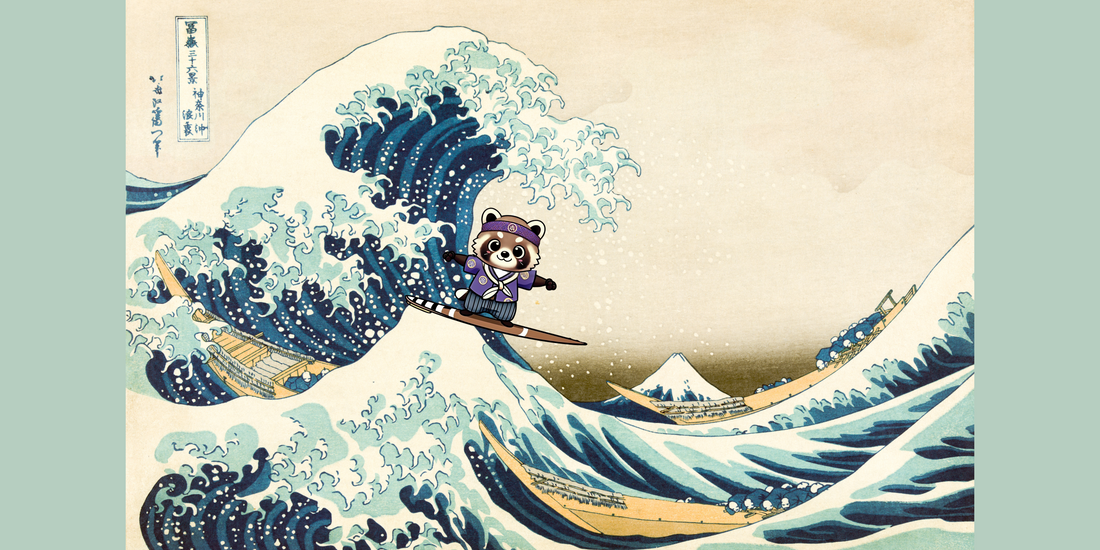
Hokusai's stylistic transformation accelerated, and a renaissance followed. Around the turn of the 1830s, he redefined landscape prints with the Thirty-Six Views of Mount Fuji (富嶽三十六景, 1830–1832). The series was announced by the publisher Eijūdō for New Year 1831 and utilized a new pigment on the Japanese market: Prussian blue (ベロ藍), paving the way for aizuri-e (monochrome blue prints) and bokashi gradients of unprecedented subtlety. This chemistry of blue met his science of composition and perspective to produce The Great Wave off Kanagawa (神奈川沖浪裏).
The last Hokusai, painter.
In the 1840s, Hokusai, now elderly, focused more on painting: ink scrolls (sumi-e), bird-and-flower paintings (kachō-ga), and landscapes of sober spirituality. He stayed in Obuse with his patron Takai Kōzan and adopted a talismanic seal Hyaku (百, "Hundred"), signifying his wish for longevity and progress. He would never leave Japan, but his brush traveled everywhere.

The dragon rising from Fuji. On the 1st day of 1849, almost ninety years old, Hokusai painted 「富士越龍図」—Dragon ascending above Mount Fuji (ink on silk, kakejiku). The work is considered one of his last, even his swan song: a snow-covered Fuji, a column of clouds like black smoke, and the ryū (龍) climbing towards the sky. The scroll is preserved and exhibited at the Hokusai-kan in Obuse. It will be on display at the Château des Ducs de Bretagne in Nantes during summer 2025, for the magnificent exhibition dedicated to the master. — and to extend the visit, see our Fuji selection.
Quote (Hokusai at 75): "Since childhood, I have had a mania for drawing. At seventy-three, I began to grasp the true nature of things. At eighty, I will have made still more progress; at ninety, I shall penetrate the mystery of things; at one hundred, I shall have reached something marvelous; at one hundred and ten, every dot and every line will be alive." (Afterword to the One Hundred Views of Mount Fuji / Fugaku hyakkei, 1834–1835).
II. All his names (gō) explained quickly and clearly
Hokusai changed his gō according to the stages of his life and ambitions — a true artistic storyboard:
-
Shunrō (春朗) — 1778-1793, in the Katsukawa studio, actor prints.
-
Sōri (宗理) — c. 1795-1798, between Rinpa (decorative) and surimono for kyōka circles; he then "passed on" this name to a student, a common practice.
-
Hokusai (北斎) — from 1807 onwards; "Katsushika" (葛飾) refers to the district of Edo, "Hokusai" reflects his faith in Myōken (North Star).
-
Taitō (戴斗) — attested by the Tametomo kakejiku (1811); the term evokes the "reception" of the polar constellation (斗).
-
Iitsu (為一, "one again") — adopted around 1819, at the age of 60; announced a new cycle.
- Gakyō Rōjin (画狂老人, "old man mad about painting") and Manji (卍) — around 1834, his twilight signature, sometimes accompanied by the Hyaku (hundred) seal in his last three years. (NB: "manji" is an auspicious Buddhist symbol.)
III. Key series and works (titles in French & Japanese)
1) Thirty-Six Views of Mount Fuji(富嶽三十六景), 1830–1832
The monumental work that redefined landscape engraving. Besides The Great Wave off Kanagawa(神奈川沖浪裏), note South Wind, Clear Sky(凱風快晴, known as "Red Fuji")and Thunderstorm Beneath the Summit(山下白雨): a visual grammar blending Prussian blue, virtuoso bokashi (gradation), oblique compositions, and micro-human dramas.
Did you know? There are actually 46 prints in this series and not 36, as its name suggests!

2) A Tour of the Waterfalls of the Provinces(諸国瀧廻り), c. 1832
Eight waterfalls magnified, including The Amida Waterfall on the Kisokaidō Road(木曽路ノ奥阿彌陀ヶ瀧). The flow is conceived as sculpted material; Hokusai almost invents a poetic fluid mechanics.

3) Remarkable Views of Bridges in Various Provinces(諸国名橋奇覧), c. 1830–1834
Eleven prints, a woodblock-engraved road movie: Kintai Bridge(錦帯橋), Suspension Bridge at the Border of Hida and Etchū(飛越の堺つりはし)… Signed Iitsu (為一), they bear witness to the aesthetic transition between his periods.

4) One Hundred Poets, One Poem Each, Explained by the Wet Nurse(百人一首姥がゑとき), 1835–1839 (unfinished)
Hokusai illustrates the famous anthology Hyakunin isshu, from the perspective of a "wet nurse" (uba). The tone is sarcastic, the visual imagination unbridled; only a few dozen prints would be completed, but the series has a unique aura.
5) Hokusai Manga(北斎漫画), from 1814
Ehon (絵本, illustrated books) of everyday sketches: gestures, trades, bestiary, caricatures. A reservoir of forms that infused all his work and the teaching of his students.

6) One Hundred Views of Mount Fuji(富嶽百景), 1834–1849
Three volumes, 102 views over the years: the Fujisan obsession condensed in black and white. It reflects his belief in the long patience of drawing (see the quote in § I). Vol. 1 (1834) and subsequent volumes are superbly documented by the British Museum.

7) Apart from the series: the Dragon scroll (富士越龍図), 1849
Let us finally mention the kakejiku of the Dragon Ascending above Fuji, painted on New Year's Day of his last year — a testamentary image where ink and emptiness (yohaku) suffice. Kogechan sees in it the ryū of late vitality: even at 90, Hokusai is still ascending.

Why Hokusai remains irresistible (and how to read his images)
- Science of line: a line that thinks — the stroke is never just an outline, it structures space.
- Modern blue: the emergence of Prussian blue allowed him to orchestrate unprecedented cold color palettes in Edo prints.
- Global perspective: chosen borrowings from the West (perspective) without abandoning Asia (Myōken, Rinpa, Kanō), nor the humor of manga.
-
Long-term vision: he championed continuous learning; his Hyaku seal and his programmatic statement attest to this.
Nice anecdote: the Hyaku seal (百, "Hundred") appeared in his later years as a personal good luck charm — and a wink to readers: "come see me when I'm one hundred and ten."
Kogechan's Conclusion
Hokusai is not "an" artist: he is a constellation of names, techniques, and obsessions, all polarized by Fuji. His life and style are a single trajectory, from the jewel-like surimono to the late scrolls, with, in the middle, the wave that swept everything away and rebuilt it all.
If this chronicle has made you want to look at a print with fresh eyes, come discover our selection of Hokusai and other ukiyo-e in KOGEDO's "Prints" collection.