
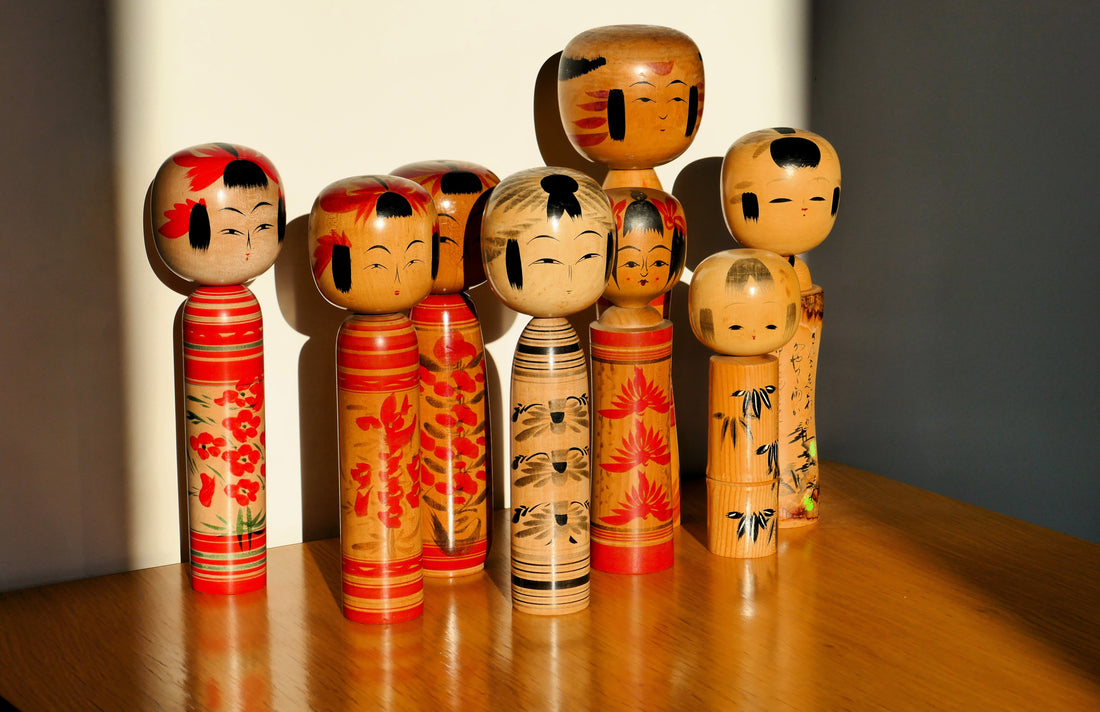
🎎 Kokeshi: small dolls, big story
They have chubby cheeks , a small smile that doesn't say it all, and a minimalist elegance that spans the centuries. Kokeshi , these wooden dolls from northern Japan , are much more than just cute objects: they embody a deep craft tradition , a link between nature, childhood, and memory. And Kogechan is a little bit in love, poko.
🌸 Where do kokeshi come from?
The first kokeshi appeared at the end of the Edo period , in the mountainous and isolated regions of Tōhoku , in northern Japan. They were sold in onsen (hot springs) by wood craftsmen called kijiya , who also made turned bowls and trays.
Originally, they were children's toys , often given as souvenirs or talismans. But little by little, they became objects of folk art , then collector's items , as their aesthetics became refined and each region developed its own style.
🧧 What is their symbolism?
Kokeshi are said to bring good luck , protect homes , and are sometimes associated with the memory of lost children . In some regions, they were given to newlyweds to wish them fertility and longevity . In others, they were placed in temples to accompany silent prayers.
They are also a symbol of transmission : A craftsman names his doll, and each hand-painted face carries a little of his spirit. Some kokeshi "look askance," others smile discreetly, and still others seem to know something we don't. This is the charm of the "floating world" in turned wood.
🔨 How is a kokeshi born?
The production is 100% handcrafted . The artisans use local woods such as mizuki (dogwood), keyaki (elm) or itaya (Japanese maple). After a long and meticulous drying process, the wood is precisely turned, then the doll is hand-painted with floral patterns, stripes, or symbols specific to each region.
The little " kui-kui" sound you sometimes hear when you turn the doll's head? It's normal. And it's even a very popular sound among doll lovers.
🗾 The 12 traditional styles (dentō-kokeshi)
There are now 12 recognized regional styles of traditional kokeshi, all from the Tōhoku region . Here's a quick overview (we'll be preparing a full article on each type very soon, poko 😉):
-
Naruko (Miyagi) – Neck often mobile, stylized red flowers
-
Togatta (Miyagi) – Large head, simple floral patterns
-
Yajiro (Miyagi) – Slender body, colorful geometric decorations
-
Sakunami (Miyagi) – Thin head, minimalist decor
-
Hijiori (Yamagata) – Soft expression, fine lines
-
Zao (Yamagata) – Wide body, dense floral pattern
-
Yamagata (Yamagata) – Stripes and flowers in a crown
-
Kijiyama (Akita) – Stocky shape, very simple decoration
-
Tsugaru (Aomori) – Bright colors, painterly style
-
Tsuchiyu (Fukushima) – Stripes all over the body, expressive face
-
Nanbu (Iwate) – Simple lines, peaceful look
- Nakanosawa (Fukushima) – Most recently recognized: simple features, original nose and eye shapes
🎨 Creative kokeshi: sōsaku-kokeshi
From the 1940s onwards, some artisans wanted to break away from traditional styles and create freer and more expressive dolls . These are the sōsaku-kokeshi (creative kokeshi ) . Their shape, their patterns, their size: everything can change. Some are figurative, others downright abstract. They are often unique pieces , very popular with collectors.
At Kogedo, we also love these modern kokeshi, especially when they have that little something unexpected... an improbable hairstyle, a sideways glance, a minimalist decor.
🎎 Kokeshi in today's Japanese culture
If you thought kokeshi were reserved for the dusty shelves of Japanese grandmothers... well, think again, poko. These little wooden dolls have become a real icon of contemporary design , and even a source of technological inspiration .
In the 2000s, Nintendo designers revealed that the appearance of the Mii avatars we created on Wii and 3DS was directly inspired by... kokeshi! Cylindrical shape, detached head, simple but expressive features: the very essence of the traditional doll has been translated into digital language. Minimalist but endearing – pure Japanese spirit.
Many contemporary designers are also revisiting the kokeshi in a pop or arty approach. The English designer Becky Kemp , for example, has designed painted wooden kokeshi representing Frida Kahlo, Picasso, and even Karl Lagerfeld – half mascots, half collector’s items.
And then... if kokeshi have a big head and a small body, doesn't that remind you of a well-known style? The "Chibi" design , found in manga and anime , refers to miniature, cute characters with exaggerated proportions . It's not official, but you could almost say that kokeshi are the wooden grandmothers of chibi .
🎴 Want to adopt a kokeshi?
At Kogedo , we select old and authentic kokeshi , mainly from the Shōwa period , with their patinas, their mysteries and their unique charm.