
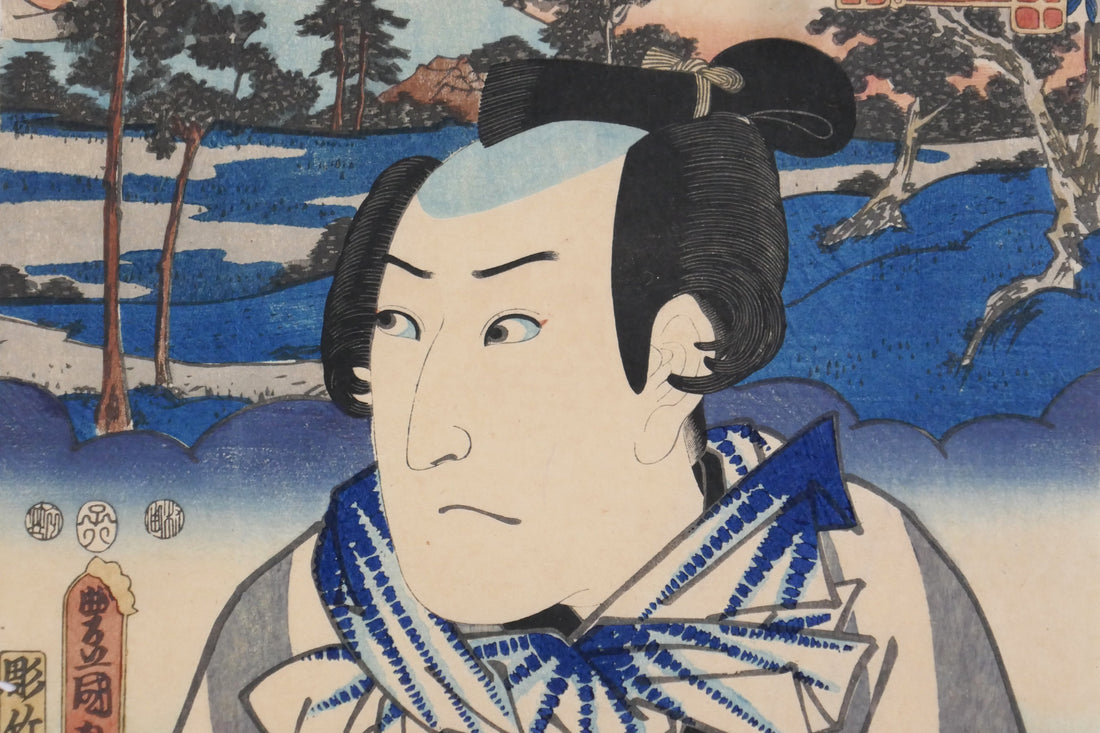
Utagawa Kunisada Toyokuni III: The master of 20,000 Japanese prints
Among the greats of ukiyo-e, Utagawa Kunisada occupies a special place. Prolific, popular, sometimes shunned by critics but adored during his lifetime, he was one of the most influential and highly regarded artists of the Edo period. And for good reason: he single-handedly immortalized thousands of kabuki scenes, elegant portraits of women, and even landscapes... but in his own unique way.
At Kogedo , we love him. And since we've selected some beautiful prints by him in our shop, we invite you to get to know this giant of Japanese printmaking better.
A meteoric rise in the Utagawa school
Kunisada was born in 1786 in Edo (Tokyo) into a modest family. At a very young age, he showed an obvious talent for drawing. In 1800, he entered the Utagawa school , under the direction of master Toyokuni I. He then adopted the name Kunisada.
As early as 1807, he published his first illustrated book, and the following year, his first prints of kabuki actors were a hit. Unlike some of his peers who took years to break through, Kunisada became a star in an instant. So much so that at the height of his career, he surpassed Hokusai and Hiroshige in popularity . Yes, just that.
An inheritance dispute worthy of a kabuki drama
In 1825, upon the death of his master Toyokuni I, it was Toyoshige (the master's son-in-law and student) who inherited the name Toyokuni II. Kunisada, convinced that he was the legitimate artistic heir, had difficulty digesting this decision.
For a time, he signed his works "Kunisada, soon to be Toyokuni II"—a polite (or not so polite) way of getting the message across. Finally, in 1844, he officially took the name Toyokuni III , and his immense output helped to put the succession disputes behind him. But the anecdote remains amusing: even in art, names matter.
An Eye on the Theater: Kunisada and Kabuki
If Kunisada had to be summed up in one word, it would probably be kabuki . He performed it thousands of times. Literally. All the great actors of his time passed under his brush, in every possible role, costume, and expression.
One could almost say that he kept a visual diary of the kabuki theater of his time. And given the volume, one might wonder if he didn't have a dedicated dressing room for the year.
His most famous series of actor portraits remain benchmarks: expressiveness, costume details, dramatic poses... it's as if you're there. A veritable museum of paper. But Kunisada didn't limit himself to kabuki. He also created several notable series, including collaborations with his friend and rival Hiroshige .
An underestimated artist... then rediscovered
For a long time, Kunisada was somewhat snubbed by critics. Too popular, too commercial, too productive, some said. But today, we are rediscovering the richness and variety of his work. With more than 20,000 drawings produced during his lifetime , Kunisada profoundly influenced the visual landscape of the Edo period.
And unlike the frozen image of traditional art, his prints have something alive, direct, almost contemporary.
➡️ Discover Kunisada’s prints in our shop
Toma :
"When I look at a Kunisada print, I feel like I'm sitting in the front row of a kabuki theater. And all this, without leaving my living room. That's the magic of ukiyo-e."