
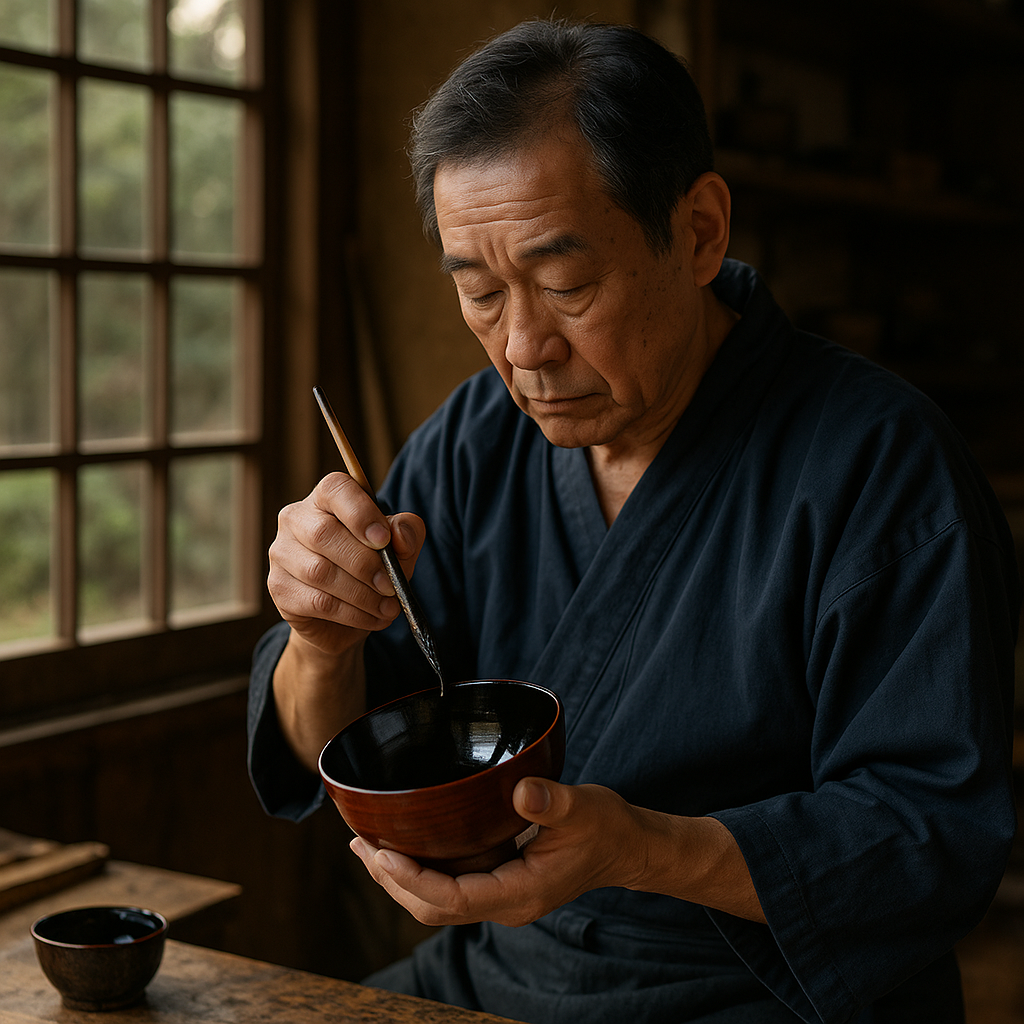
Urushi Japanese lacquer: manufacturing, history, and craftsmanship
🏮 Japanese Urushi Lacquer: Where Patience Becomes Light
🌸 Urushi: More Than Just Lacquer
At the antique markets of Kanazawa, Kogechan often comes across black bowls so shiny they seem to be made of liquid night.
"Urushi," the seller tells her.
Not a brand name — the word "urushi" (漆) refers to the natural sap extracted from a tree, the urushi-no-ki.
But beware, in Japan, we don't confuse everything:
- Urushi is the material, the sap and the lacquer itself.
- Shikki (漆器) are the objects made with this lacquer: bowls, boxes, inrō, trays...
- And nuri (塗り) is the style or manner of applying the lacquer — hence the famous Wajima-nuri or Aizu-nuri.
Each word tells an aspect of this ancient art.
And all together, they summarize what we love: the marriage of technique, gesture, and time.

🌿 An Ancient History, Shaped by the Japanese
The history of Japanese lacquer begins millennia ago.
Bowls covered with urushi dating back to the Jōmon period (9000-300 BCE) have been found.
Nine thousand years, folks. Nine. Thousand. Years. And some of these bowls still retain their original luster (well, almost...).
During the Nara (710–794) and Heian (794–1185) periods, lacquer became a refined art.
Buddhist temples, incense boxes, samurai armor, and court combs were adorned with urushi.
But the brilliance of Japanese lacquer is not that of ostentation — it is a silent brilliance, born of patience.
🌳 The Lacquer Tree
Urushi comes from a tree called urushi-no-ki (Toxicodendron vernicifluum).
Its trunk is carefully incised, and it "weeps" a milky sap: this is raw urushi.
Each tree yields barely 250 grams of this precious resin per year.
This sap contains a molecule called urushiol, from the same family as poison ivy.
Before being processed, it can cause severe skin irritation.
The harvesting artisans, the urushi-kaki, are rare and respected.
Their movements are precise, almost ritualistic. Each tree bears the scars of several seasons of harvesting, and some masters know every trunk like an old friend.
It is a relationship of respect: only what the tree is willing to offer is taken.

⚗️ From Sap to Light: The Making of Japanese Lacquer
Once harvested, the sap is filtered and beaten until it becomes a translucent paste called ki-urushi.
This is the basis of everything.
Then, the lacquer artisan — the urushi-shi (漆師) — enters the scene.
The process is fascinatingly slow:
- Application of a first layer on the wood.
- Drying in a humid room (furo), because urushi hardens with humidity.
- Fine sanding, polishing, new layer.
- And so on.
Making a piece of Japanese lacquer is a marathon, not a sprint: between preparation, dozens of layers, and drying times, it often takes several weeks, sometimes months, to complete a single shikki.
A successful lacquer bowl is therefore as much a technical feat as an act of meditation.
💬 Kogechan's Fun Fact: Some artisan families still have "furo" (drying rooms) where humidity is naturally controlled with charcoal and water basins. It's chemistry... without chemicals!

🎨 The Great Techniques of Japanese Lacquer
Japanese lacquer does not merely cover: it decorates, it sculpts, it illuminates.
Among the major nuri techniques are:
- Maki-e (蒔絵): gold or silver powder is sprinkled onto still-wet lacquer.
- Raden (螺鈿): mother-of-pearl inlay.
- Negoro-nuri (根来塗): red over black, with lower layers reappearing with use.
- Kanshitsu (乾漆): objects molded from lacquered hemp, both light and strong.
Each nuri style reveals the artisan's hand and the philosophy of their region.
The result: unique shikki, combining function and timeless beauty.


👉 Coming soon on the blog: chronicles of different lacquer techniques!
🏔️ Major Centers of Japanese Lacquer
Japan has several historic lacquer centers. Among the most famous:
- Wajima (Ishikawa): famous for Wajima-nuri, a robust shikki made with diatomaceous earth powder.
- Aizu (Fukushima): renowned for its refined and finely gilded Aizu-nuri.
- Kanazawa: a city of gold and lacquer artisans, where urushi meets gold leaf.
- Kyoto and Kamakura: more sober lacquers, linked to religious arts and Zen tradition.
Each region perpetuates its nuri style and signature.
And many of the ancient shikki that KOGEDO uncovers come from these workshops, where time still seems to be measured by the rhythm of the brush.

![]() 🍵 Lacquerware: From Rice Bowl to Artisan Treasure
🍵 Lacquerware: From Rice Bowl to Artisan Treasure
Urushi has covered all everyday Japanese objects:
from miso soup bowls to incense boxes, from inrō suspended from samurai belts to jewelry boxes and delicately decorated combs.
But be careful — do not confuse real Japanese lacquer with "lacquer-style" plastic bowls!
Real shikki are cold to the touch, their brilliance seems to come from within, and they develop a patina over time.
Plastic, on the other hand, ends up dull and soulless.
💬 Kogechan's tip: To care for shikki, a simple soft cloth is enough. No hot water, no sun, no stress. Lacquer loves slowness.

🕊️ Japanese Lacquer, or the Beauty of Slow Time
Urushi is the opposite of rushed modernity.
It requires time, calmness, and a steady hand.
Each lacquer bowl, box, or natsume is a small lesson in philosophy: nothing beautiful is made quickly.
Japanese shikki are proof that craftsmanship can defy centuries without losing its poetry.
👉 Discover the treasures of Japanese lacquer on KOGEDO
💬 FAQ — Japanese Urushi Lacquer, Shikki, and Nuri
What is Japanese urushi lacquer?
→ Urushi is a natural sap extracted from the lacquer tree (urushi-no-ki), used in Japan for over 9,000 years to coat and protect artisanal objects.
What is the difference between urushi, shikki, and nuri?
→ Urushi refers to the material, shikki to lacquered objects, and nuri to the techniques or regional styles of application (such as Wajima-nuri or Negoro-nuri).
How can you recognize real Japanese lacquer?
→ Real urushi lacquer is cold to the touch, slightly satiny, and its shine seems to come from within. It is not to be confused with "lacquer-style" plastic bowls.
How long does it take to make a lacquered object?
→ Between harvesting, preparation, and multiple layers, it often takes several weeks, sometimes months, to complete a single shikki.
Where are the most famous Japanese lacquers made?
→ In Wajima, Aizu, Kanazawa, and Kyoto — each with its own nuri tradition and unique style.