Maneki-neko: The Japanese cat that beckons and invites
What is a Japanese Maneki-neko?
We've all come across a maneki - neko , that mischievous little cat that raises its paw . But did you know that it's not just a cute trinket? Behind this icon of Japanese culture lies a fascinating story, between legends, temples and symbolism . And if you're looking to get your hands on an antique maneki-neko from the Showa period , stay until the end. You'll see that these pieces, in addition to being lucky charms, are true works of art .

A mysterious origin (and a legend full of twists and turns)
"The term maneki-neko comes from the Japanese maneku (invite or call) and neko (cat), which literally translates to ' inviting cat '."
The story of the maneki-neko begins with a legend —because of course, in Japan, everything has a legend. The most famous version takes place during the Edo period , in a small, dilapidated temple. A wealthy samurai , seeking shelter from the rain, spots a cat waving at him (or grooming itself, but let's stick with the myth). Intrigued, he follows the cat into the temple. No sooner has he left his shelter than a lightning bolt strikes the spot where he had been standing a few seconds earlier. Saved by a cat ? That deserves good luck status.
Why he waves (and not cuckoos)
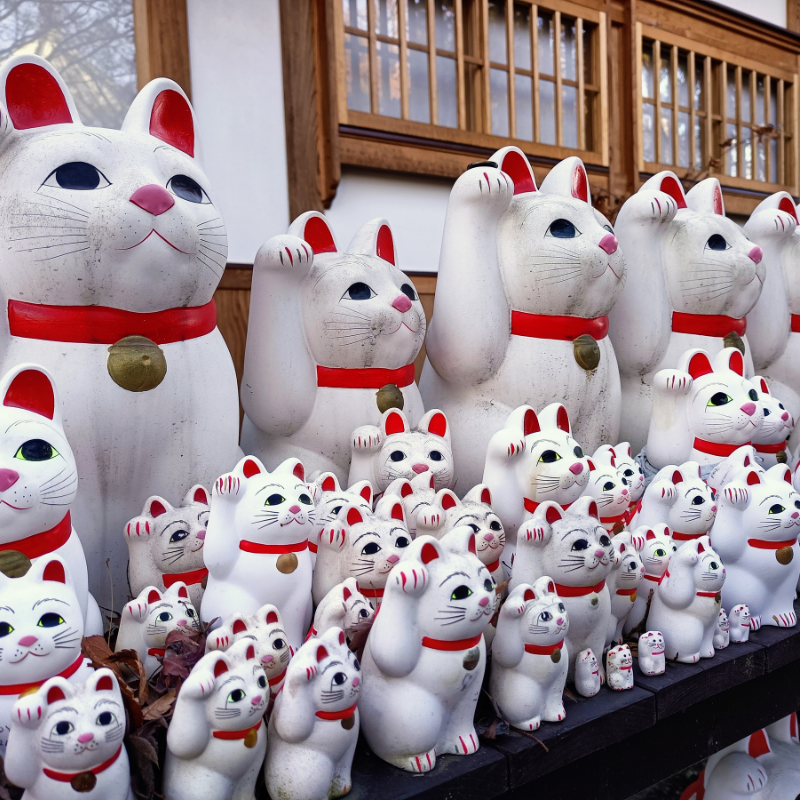
This raised paw gesture isn't just an invitation to chat. In Japanese culture, this movement is a call. The cat seems to be saying, "Come here, fortune awaits you!" Depending on which paw it raises:
- Left paw raised : It attracts friendship and customers . Perfect for merchants.
- Right paw raised : It attracts money and luck . This is more for your wallet.
And for the more ambitious, there are maneki-neko with both paws raised . But be careful, too much luck at once could cause your karma to explode.
Fun fact : the Japanese use this hand sign, palm down and downward movement of the hand and fingers to ask someone to come closer, in France we do the opposite! We make an upward movement with the palm facing up to invite someone to come closer. Be careful not to get the wrong direction because in Japan the upward movement of the hand is a sign of provocation!
A colorful style
If you thought all maneki-neko were white, think again. Each color has its own meaning :
- White : Purity and luck. Classic and effective.
- Golden : Money, obviously. It doesn't get any more explicit than that.
- Black : Protection against evil spirits (and bad payers?).
- Red : Good health. Perfect for doctors' waiting rooms.
- Pink : Yes, there is a chat to find love. Try it.
- Tricolor (predominantly white, with red and black spots): these are reputed to be very good luck charms!
The maneki-neko 's accessories , such as the red collar, the bell, or the gold coin held in its paw, add an extra touch of symbolism. For example, the coin is often engraved with the word senman ryo , which evokes immeasurable wealth. In Japan, nothing is left to chance!
A sacred symbol: Temples dedicated to the maneki-neko
To understand the importance of maneki-neko in Japan, head to Gotokuji , a temple nestled in a quiet neighborhood of Tokyo. Considered the origin of the legend mentioned above, this temple is today a true sanctuary for maneki-neko lovers (and otaku) .

Another must-see is Imado Temple in Asakusa . Here, maneki-neko are also associated with love and relationships. A visit is a must if you're looking for a romantic boost (or a cute selfie surrounded by cats).
In Japanese culture (and far beyond)
The maneki-neko is everywhere. In shops , where it serves as a lucky mascot . In homes , where it watches over finances. But it doesn't stop there: it has also become a pop icon . It can be found in manga ( DanDaDan of course!), advertisements , and even as a mascot for a karaoke channel !
And for hardcore fans, there's a museum dedicated to the maneki-neko in Seto , near Nagoya. Yes, an entire museum filled with paw-waving cats. A must-see at least once in your lifetime.

So, does it really work?
Will putting a maneki-neko on your desk really bring you luck and prosperity? It's a mystery. But one thing is certain: it brings a little burst of good humor , and that's priceless (well, yes, the cat's price).
Varied styles according to the era: focus on the Showa era
Modern maneki -neko , often in golden plastic (cute but not really our style...) Fans know that they are no match for older models, especially those from the Showa era (1926-1989).
During this period, maneki-neko were crafted from ceramic with meticulous attention to detail. Each piece told a story : the hand-painted designs, delicate expressions, and subtle embellishments made them more than just lucky charms. These cats had real personalities, and they were often built to last, unlike today's mass-produced models.
Showa maneki -neko , with their vibrant colors and vintage charm , are now highly sought after by lovers of Japanese crafts . Owning one of these treasures is like having a piece of history in your home.

Conclusion: Adopt a lucky charm (that doesn't meow)
The maneki-neko is more than just a trinket. It's a symbol, a living legend, and a great excuse to believe in luck. So, whether it's to attract money, love, or just a smile, don't hesitate to invite one of these little cats into your home. If you're looking for a maneki-neko that combines history, elegance, and symbolism, take a look at our collection on Kogedo . Because, as Kogechan would say: "Fortune always begins with a cat calling us."