
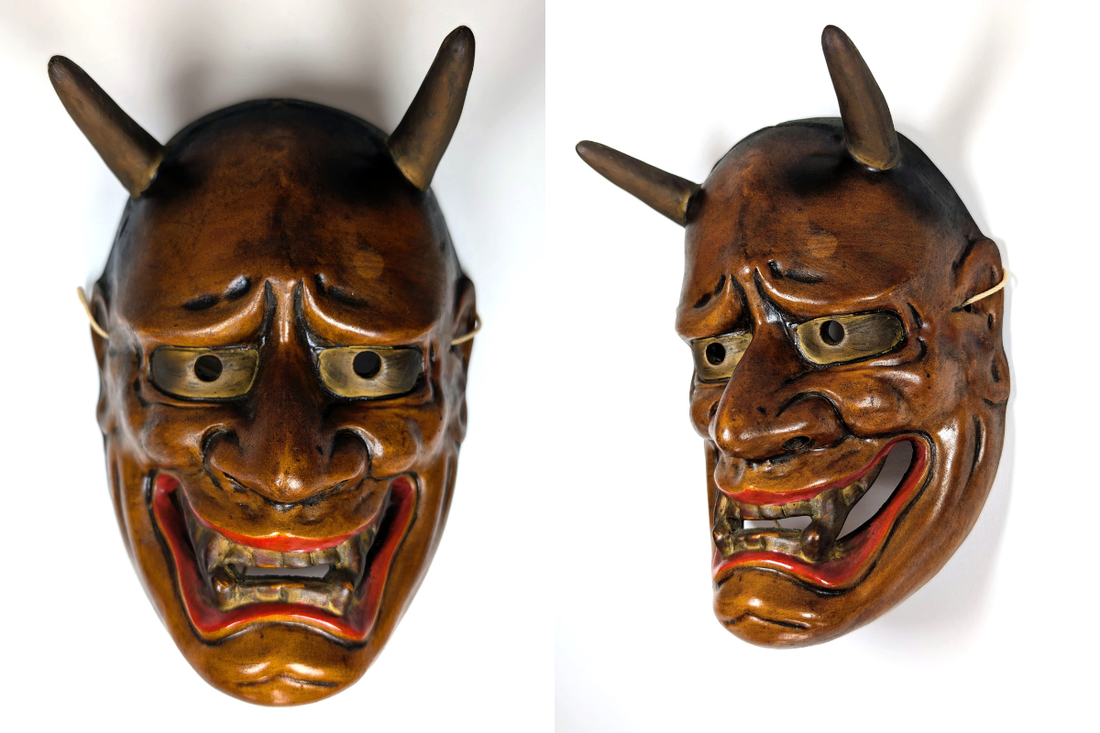
Hannya, the Tragic Love of Nō Theater
Hannya, beauty devoured by jealousy
Her face is frightening, but her story is moving.
Behind the Hannya mask, it is not a demon we see.
It is a woman. A woman who loved too much.
💔 From love to metamorphosis
In Nō theatre, Hannya 般若 embodies a woman consumed by jealousy.
Her love betrayed, her heart torn apart — and from this pain is born monstrosity.
Little by little, her face contorts.
Horns grow, teeth clench, eyes blaze with an inner fire.
But behind the rage, something human remains: a sadness that nothing can extinguish.
Hannya was not born evil.
She is the reflection of a passion that became poison.

👹 The mask: frozen fury
The Hannya mask is one of the most powerful in Nō.
Its beauty lies in its contradictions:
- horns, but a still feminine face,
- a grimacing mouth, but moist, almost tearful eyes,
- a smile of rage, but the features of a wounded woman.
Under certain lights, it appears ferocious.
Under others, distress can be read in it.
The sculptor carved pain into the wood — every angle, every shadow breathes the tension between hatred and love.
To learn more about the masks of Nō theatre, discover our article [🎭 Dōji, not (really) a child] — another in-between face, luminous and elusive.
🎭 Where is she seen on stage?
Hannya appears in several classic Nō plays, often at the moment when human passion tips into the supernatural:
- Aoi no Ue (葵上): Lady Rokujō's jealousy transforms into a vengeful spirit that haunts Genji's wife.
- Dōjōji (道成寺): a young woman betrayed by a monk turns into a serpent-demon and destroys the temple where he took refuge.
- Kurozuka (黒塚): an old solitary woman hides a demon within her, born of loneliness and rejection.
Each time, the Hannya mask marks the turning point — when suffering becomes monstrous, but always terribly human.
Why does this character move us?
Because it tells something deeply true:
love, when it becomes pain, can deform even the most beautiful faces.
But Hannya also represents possible redemption.
On stage, she is often freed from her anger by the compassion of a monk.
And in this silent cry, a form of tragic beauty is found — that of a heart that only wanted to be loved.

💫 Hannya today
The face of Hannya no longer belongs solely to Nō theatre. Today it can be found in manga, video games, and even in Japanese urban culture.
In Rurouni Kenshin, the character Han’nya hides her identity behind a mask inspired by Nō, a direct echo of the duality between beauty and pain.
In video games, she is reborn in other forms: in Ghostwire: Tokyo, the masked antagonist Hannya embodies the spiritual anger of modern Japan; in Shin Megami Tensei and Persona, she becomes a summoned demon, a figure of transcendent despair; in Rise of the Rōnin, the demon masks that can be worn clearly adopt her horned and feminine features, symbols of inner power and hidden wounds.
Even in fashion or Japanese tattoos, her face persists, sometimes a talisman, sometimes a warning.
From the Nō stages to the pixels of our screens, Hannya remains this mirror of the human soul: beauty deformed by passion, the fire of a love turned into hell.
👉 Do you want to see the face of this legend?
Discover our ceramic Hannya, in the collection.