
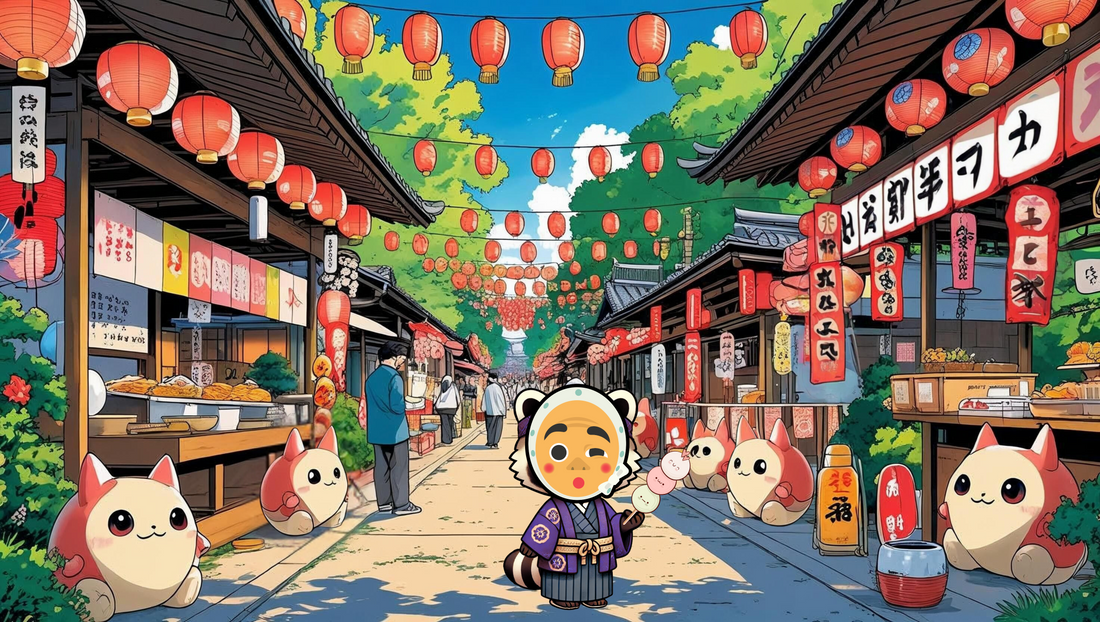
Hyottoko: history of a comical Japanese mask between theatre, legend and pop culture
Kogechan tells the story: Hyottoko, the man who blows askew (and travels through the centuries)
So there I was. I was hunting in a market near Tokyo, between a dusty maneki-neko stall and a lacquer box that smelled of stale sake, when my gaze met his…
A mouth that crooked to the side like an uncontrolled gust, round eyes like taiko drums, puffed-up cheeks… I had stumbled upon a Hyottoko.
And then, naturally, I, Kogechan, felt that behind this funny face lay a much deeper story. Come on, follow me.
🔥 Legend of gold and fire
Hyottoko isn't just a funny name. It's a contraction of hi (火, fire) and otoko (男, man). Basically: "the man of fire". And fire, in Japan, isn't just for cooking gyoza: it's the life of the home, purification, the domestic spirit.
But what's great is his legend. In Iwate, in the Tōhoku region, the story is told of a boy named Hyoutokusu. A child unlike any other: he produced gold from… his navel. Yes, you read that right!
After his death, his mother is said to have crafted a mask in his image to attract luck and prosperity. This mask, hung above the fire, protected the house. Hyottoko thus became a tutelary spirit of the home, but also a comical figure and a symbol of happiness.
His blowing expression comes from that: blowing on the embers, keeping the fire alive, keeping the house alive.
🎪 Festival and furnace mask
Hyottoko, in matsuri (Japanese festivals), is the king of eccentricity. He dances as if one leg is shorter than the other, blows, grimaces, spins, twists… And often, he is accompanied by Okame, his plump companion with a fixed smile.
Their duo makes both young and old laugh, but not just for the atmosphere. In tradition, laughter chases away evil spirits, and Hyottoko's comic dance also has a role of spiritual protection. By making the gods laugh, one attracts their mercy.
🎭 Hyottoko in theater: welcome to Kyōgen
But what I love most about him is his role in Kyōgen theater. You know, that comic form played between two very serious Nō plays.
Kyōgen is a bit like ginger between two sushi: it wakes you up.
Hyottoko becomes a grotesque and cunning character, often a peasant, a servant, or a happy fool. The mask, exaggeratedly expressive, allows for laughter without saying a word. His fixed gaze, his twisted mouth, everything is there to convey emotions through simple body movement.
The mask I found for KOGEDO? It's clearly one of those. Carved from solid wood, probably kusunoki, with admirable precision. You can feel every relief under your fingers. It's a piece with a history, a soul even.
🪓 Wood, paper and company
Traditionally, Hyottoko masks are made of papier-mâché (hariko). It's light, cheap, practical for running through the streets during a festival.
But the most beautiful, the rarest, are made of carved wood. They can be found in camphorwood, katsura, sometimes paulownia, and even metal for ritual uses. Each material gives a different character to the mask.
📺 Hyottoko, unintentional star
And today? Hyottoko hasn't faded with the matsuri lanterns. He has even made his entry (discreet but significant) into Japanese pop culture.
In Demon Slayer (Kimetsu no Yaiba), you may have noticed that the blacksmiths — notably Hotaru Haganezuka, who forges Tanjirô's swords — wear a very… blowing style mask. Although the name is not explicitly mentioned, the connection is obvious.
This mask:
- recalls fire, central to their craft,
- protects their secret identity,
- and evokes an assumed folkloric aesthetic.
Hyottoko, without saying a word, continues to fan the flames of Japanese culture, even in the most modern works.
🧾 In summary
- Hyottoko: legendary character from Tōhoku, spirit of fire
- Present in popular dances, festivals, and Kyōgen theater
- Masks often made of papier-mâché, but sometimes of solid wood
- Still alive in pop culture, even in the forges of Demon Slayer
- A collectible item, to display, to talk about
👉 Discover KOGEDO's Hyottoko mask, it's a rare piece.
I'll leave you now. I have a tea bowl to negotiate with a grumpy old merchant. But I'll see you very soon for a new chronicle from Kogechan — your favorite antique dealer, tanuki mustache included 🐾