
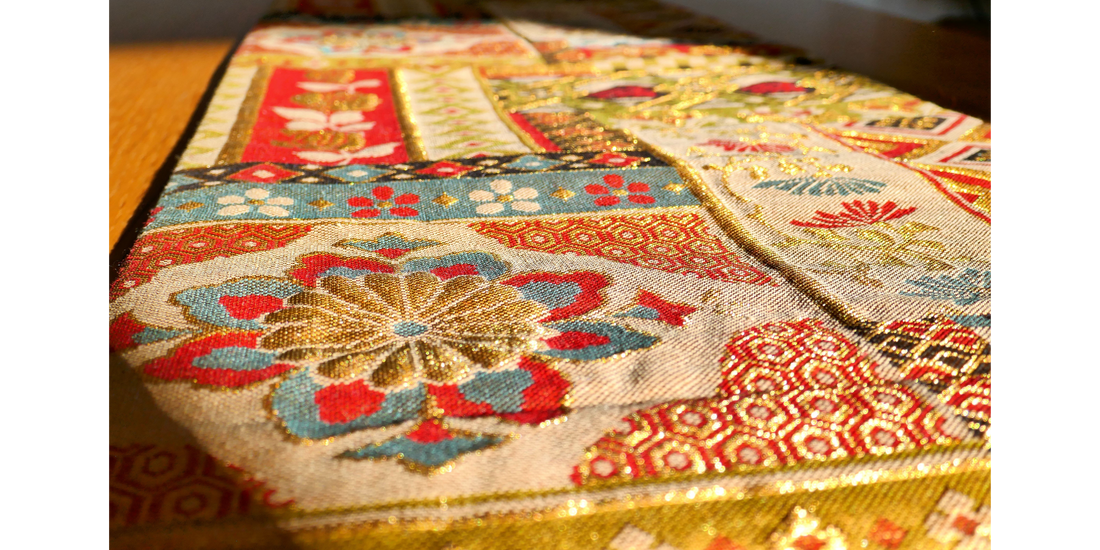
Japanese decor ideas: enhancing your interior with a silk obi
Japanese silk obis: artisanal treasures to enhance your home decor
If the kimono is the king of traditional Japanese clothing, then the obi is undoubtedly its crown.
This wide Japanese silk belt, tied at the back, is a true textile work of art.
But did you know that these vintage Japanese obis are not limited to fashion and can become incredible pieces of interior decoration?
Tie your obi tightly (figuratively speaking, of course), we're going to reveal everything about this Japanese craft and how to give it an elegant second life in your home!

The Japanese obi: a belt, but above all a textile masterpiece
Originally, the obi was just a simple ribbon used to close kimonos. But over the centuries, it has become a true symbol of Japanese refinement, evolving into a wide strip of woven or embroidered silk with sumptuous patterns.
💡 An obi can be up to 4 meters long! So it's not tied lightly...
Its manufacture is a goldsmith's work, carried out by Japanese textile artisans who master weaving, embroidery, and sometimes even the inlay of gold or silver threads.
Each obi reflects a particular style, era, and technique:
- Maru obi: The most sumptuous and luxurious, entirely embroidered on both sides.
- Fukuro obi: More modern, with only one decorated side, but still very elegant.
- Nagoya obi: Shorter and more practical, often worn with everyday kimonos.
- Hanhaba obi: Half-width, light and flexible, perfect for yukatas and casual looks.
- Heko obi: Flowing, ethereal, worn by children or for informal styles.
- Tsuke obi (or tsukuri obi): Modern pre-tied obi, very practical.
💡 A detailed guide on types of traditional Japanese obi is coming in a future Kogechan column!

Wearing an obi: an art (almost) reserved for experts
If you've ever tried to tie a traditional obi, you know it's anything but simple.
Some knots require meters of fabric, complex folds, and often external help (in Japan, it's not uncommon to be dressed by a kitsuke specialist, the art of wearing a kimono).
So, even if wearing an obi with a kimono is an incredible experience, let's be honest: it's not something you do every morning before going to work. Fortunately, there's a brilliant alternative: incorporating these exceptional pieces into your Japanese decor.
Why collect a silk obi today?
💎 A unique and refined textile
A vintage Japanese obi is much more than a simple piece of fabric. It's a work of art.
Each pattern, each weave tells a story, with floral, geometric, or even mythological inspirations.
The luster of the silk, the deep colors, the fineness of the weave make it an interior decoration element of rare elegance.
🌱 A durable and timeless piece
By purchasing an antique obi, you are giving a second life to a piece of traditional Japanese craftsmanship that deserves to be preserved.
It's durable, beautiful, and rich in history. And above all: it's unique.
Obi and decor: how to incorporate them into your home?
If you don't have a kimono to tie around your waist (and want to avoid the headache of the perfect knot), here are 3 great ways to use a Japanese silk obi in your home:
1. Refined table runner
A vintage Japanese obi placed on a table instantly transforms the ambiance.
With its delicate weaving and sumptuous patterns, it elegantly replaces a table runner and brings a traditional Japanese touch to your dining room.

2. Curtain or wall covering
Arrange several obis side by side on a wall rod to create a unique Japanese textile panel.
It immediately dresses up a space with an elegant and original Japanese touch.

3. Silk headboard
Attach one or more silk obis behind your bed, as a decorative headboard.
The effect is sublime and gives your bedroom a zen, warm, and refined feel.
4. Ultra-chic cushion
An obi can also be transformed into a cushion cover!
With its thick and textured fabric, it's an excellent idea for Japanese textile upcycling for subtly Japanese decor.

Japanese silk obi: which decor for your home?
If you love the elegance of Japan and are looking to incorporate a piece of ancient textile art into your home, a vintage obi is a perfect choice.
🎐 Browse our selection of antique Japanese obis on our online store, sourced directly from antique markets in Japan.
So, are you more of a table runner or a wall panel? 🎌
Tell us in the comments how you would like to incorporate these wonders into your decor universe!