
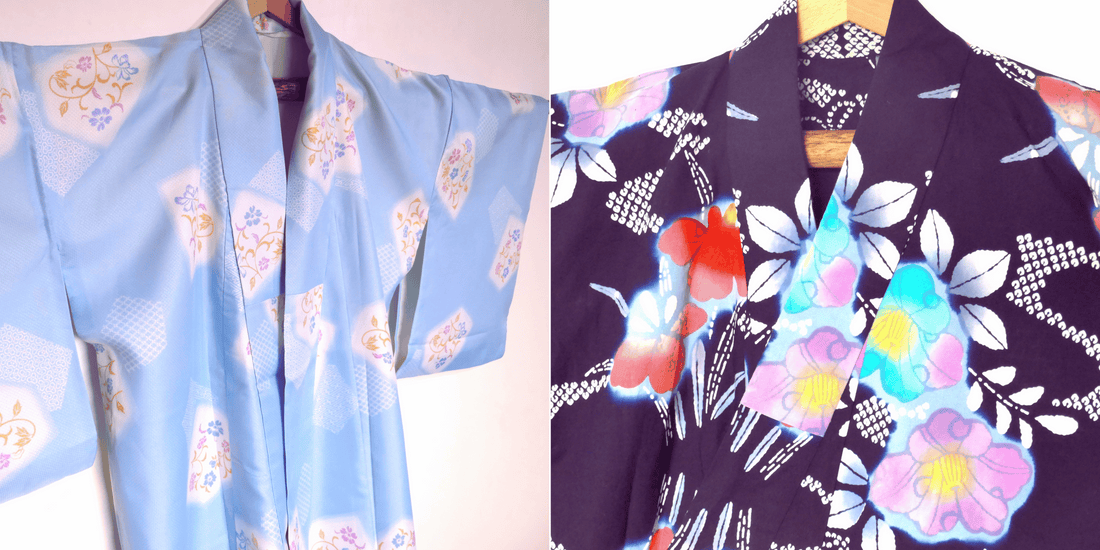
What is the difference between a kimono and a yukata?
Kimono vs. Yukata: Never Make the Mistake Again!
Do you think you’ve mastered Japanese style? Imagine this: you proudly arrive at a super chic ceremony in a yukata, or worse, you’re sweating profusely in a kimono at a summer festival. Oops. Don’t panic! Before you commit a Nippon fashion faux pas, here’s everything you need to know so you never confuse kimono and yukata again.
Ready? Tie your obi (the sashes, not your seatbelts), let’s go!
Kimono and Yukata: Cousins, but Not Twins
👘 The kimono is the traditional Japanese attire par excellence. Elegant, often made of silk, it is worn for grand occasions: weddings, tea ceremonies, New Year, festivals, fancy outings with friends or a partner... In short, if you see someone in a kimono, it means there’s a high level of formality.
👘 The yukata is the kimono’s casual little brother. Light, made of cotton, it is meant to be worn in summer, during festivals (matsuri) or... for sleeping in a ryokan (traditional Japanese inn). Yes, in Japan, a yukata also serves as chic pajamas!
The 3 Main Differences Between a Kimono and a Yukata
💡 1. The fabric: Silk VS Cotton
Kimono: Primarily made of silk or refined materials. Elegant, flowing, it can cost an arm (or even two if it's an exceptional piece).
Yukata: Made of cotton or linen, it is light and breathable. Perfect for summer, and above all, much more practical and affordable.
💡 2. The number of layers: Structured VS Simple
Kimono: It is worn with several underlayers, a nagajuban (under-kimono), a stiff collar, and accessories to keep it in place. It requires time and expertise to put on correctly.
Yukata: You put it on like a bathrobe. No under-kimono or complicated multiple layers. Just a yukata and a light obi. Easy, quick, efficient.
💡 3. The occasion: Grand ceremonies VS Daily life
Kimono : Weddings, tea ceremonies, official outings, Noh theater… A kimono is serious business.
Yukata : Summer evenings, festivals, onsen (thermal baths), ryokan… Comfortable and casual.
The Ultimate Faux Pas: Wearing a Yukata to a Wedding (or a Kimono to Sleep)
Imagine the scene. You're invited to a traditional Japanese wedding and you show up in a yukata. Big mistake. It's like going to a gala in flip-flops. Or worse, Birkenstocks. That's a huge NO 🙅.
Conversely, wearing an ultra-refined kimono for a night out with friends or a summer festival is a bit much. You'll sweat like a sumo after a match, and people might ask you why you're so overdressed.
💡 Golden Rule: Kimono = dressed up and chic / Yukata = light and casual.
Fun fact: The yukata, Japan's official pajamas
Are you staying in a ryokan (traditional inn) or an onsen (thermal bath) in Japan? You'll be given a yukata for the night. And yes, there, it's completely normal to walk around in a yukata in the hotel hallways, even for dinner. It's part of the charm!
But beware: if you leave with the yukata from your room... that's theft! (Yes, even if it's cotton. Put that back in your suitcase, Kogechan, right now.)
How to properly wear your kimono or yukata?
1️⃣ Always cross the left side over the right. The reverse is reserved for the deceased. Seriously.
2️⃣ Adjust the obi properly: A poorly tied obi is a bit like a botched tie knot. Learn, or ask for help.
3️⃣ Adapt the outfit to the event: Avoid yukata for grand occasions and ultra-refined kimonos for summer festivals.
So, team kimono or team yukata?
You now know the difference between a kimono and a yukata. You'll never make the mistake again at a party (or worse, while traveling in Japan 😱). Our collection of kimonos and yukatas can be found here.
And if you want a kimono-inspired garment that's modern and easy to wear, check out our creations at Atelier KOGEDO. Elegant, comfortable, and perfect for a Japanese-inspired look without the fuss!
📢 Team Kimono or Team Yukata? Tell us in the comments your preference (and if you've ever had an awkward moment wearing one instead of the other 😆).