Utagawa Kuniyoshi invites fantasy into Japanese prints
In the great family of ukiyo-e artists, Kuniyoshi is a free spirit, a visual storyteller, a lover of epic tales... and probably one of the most original illustrators of the Edo period. Between tattooed samurai, wacky monsters, and giant talking fish (yes, really), Kuniyoshi depicted a vibrant, heroic, and fantastical Japan.
At Kogedo , he is held in high esteem. Because he dared, he dreamed, and above all: he drew like no one else.
A young talent nourished by silk and stories
Born in 1797 in Edo into a family of silk dyers, Kuniyoshi was immersed in the world of colors and patterns from an early age. At 14, he entered the workshop of Utagawa Toyokuni I (the same as Kunisada, by the way) and took the name Kuniyoshi.
At first, his career struggled to take off. It wasn't until the 1820s that his luck changed, with the commission that would change everything...
The Heroes of Suikoden: The Series That Propelled Him
He is best known for his series of 108 heroes of Suikoden . Inspired by a popular Chinese novel, it features vigilante bandits with tattooed bodies, either in combat or in ultra-stylish poses.
These images, with their raw energy, left their mark on their era. Young people in Edo even used them as tattoo designs—a first in the history of printmaking.
Toma :
"What I like about Kuniyoshi is that he doesn't just depict. He tells stories. His prints are illustrated novels in one image. And sometimes, you see things in them that you've never seen anywhere else."
An artist who never confined himself to a style
Kuniyoshi is the kind of artist who can't be pigeonholed. Warriors, yokai, mischievous animals, elegant beauties, caricatures... He's a dab hand at everything. He can illustrate a bloody battle one day, and draw sumo-wrestling cats the next.
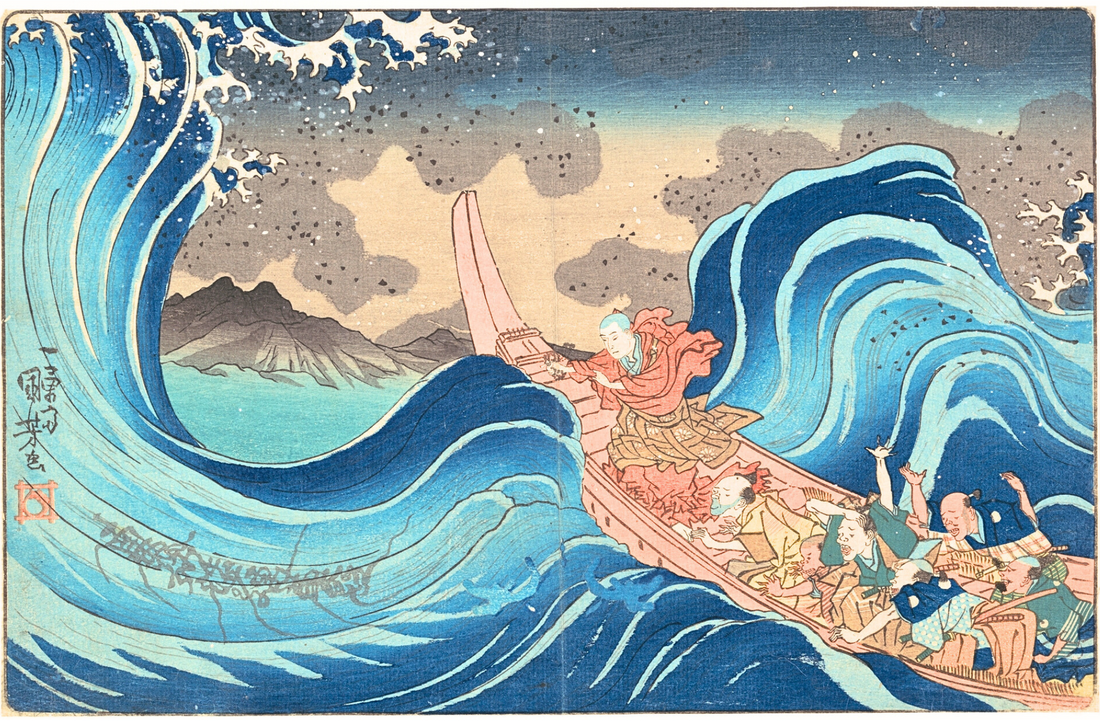
And even in his landscapes, we sense a teeming imagination: undulating mountains, swirling waters, hidden creatures... His Japan is as real as it is fantastic.
But be careful, Kuniyoshi didn't only deal in the spectacular or the supernatural. He also produced many more classic series, such as yakusha-e (portraits of kabuki actors) and bijin-ga , with as much mastery as originality.
The art of circumventing censorship (with humor)
During the Tenpō Reform period (1830s), artists were subjected to strict censorship. Gone were shunga, social criticism, and luxury images.
But Kuniyoshi, as clever as a fox (or a tanuki, poko!), finds solutions. He slips in coded messages, replaces humans with fish or humanized animals, and turns everything into ridicule. The result: he amuses while denouncing. A sort of Charlie Hebdo of prints.
An endless imagination, and a lasting influence
Over the decades, Kuniyoshi became a key figure. He trained students such as the very famous Tsukioka Yoshitoshi. (which we also love), and his explosive style has had a lasting influence on Japanese printmaking. But his influence goes far beyond that: today we find nods to his works in manga , video games , and of course in the world of Japanese tattooing , where his tattooed warriors continue to inspire generations of needle artists.
It is undoubtedly this instinctive modernity, this narrative and visual side so close to today's codes, which explains why Kuniyoshi is today one of the most popular print artists with the general public . He already spoke our language, but with a brush and washi paper.
And if you ever pass through the charming town of Kurashiki , don't miss the Kuniyoshi Museum : a little marvel nestled in the historic district, which we were lucky enough to visit. An inspiring place, just like the artist himself.