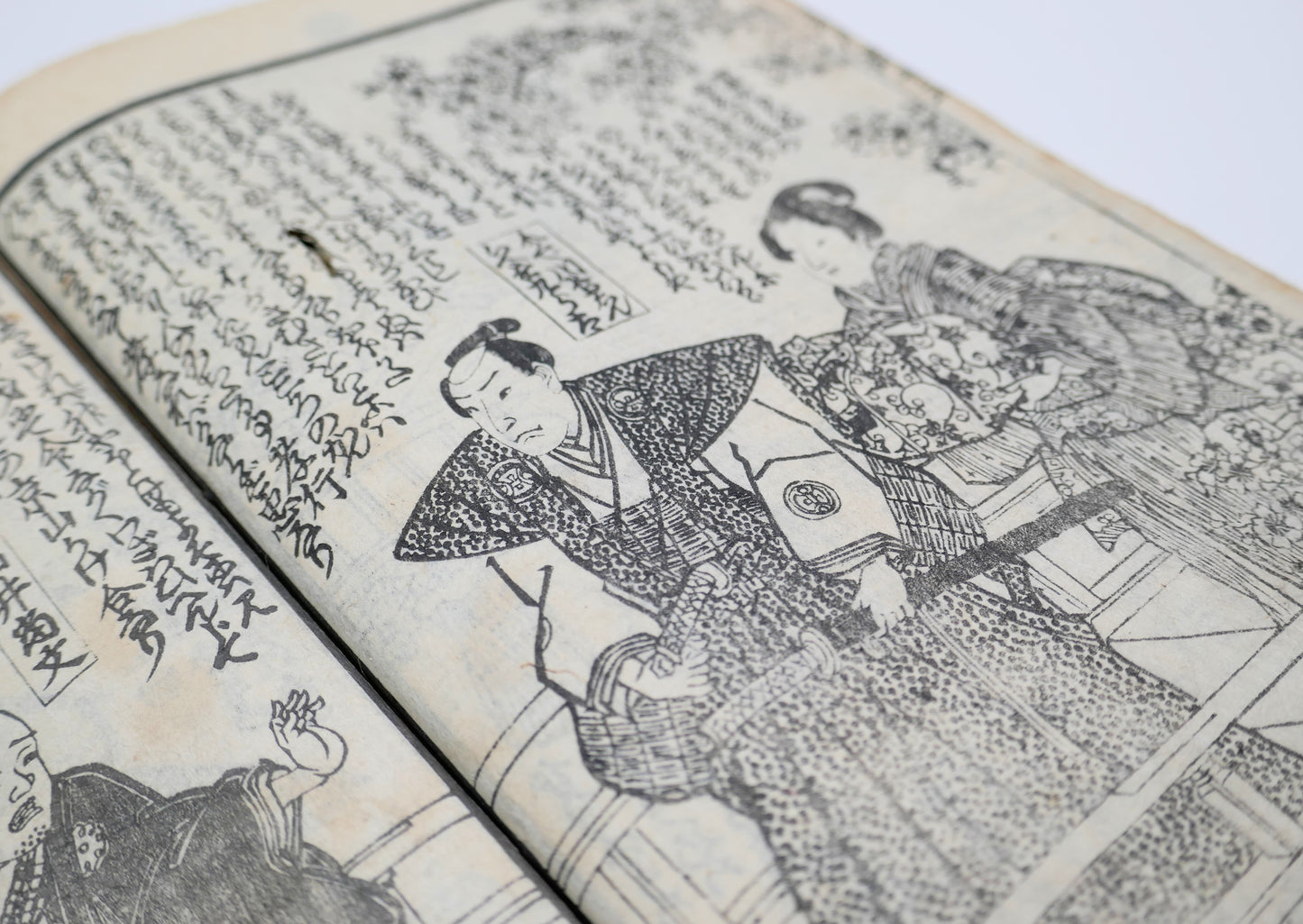
Object Type: E-hon 絵本 / gōkan 合巻, ancient Edo manga, original Japanese illustrated book printed by woodblock
Title: Kinsei Bijin-roku 琴声美人録 — The Record of Beauties with the Sound of Koto
Volume: Thirteenth part, lower volume / second volume 十三編 下 Jūsan-ben ge
Author: Santō Kyōzan 山東京山
Cover cartouche: 京山作 Kyōzan saku, work by Kyōzan
Illustrator: Utagawa Yoshikazu 歌川芳員
Cover cartouche: 芳員画 Yoshikazu ga, drawn by Yoshikazu
Publisher: Sano-ya Kihei 佐野屋喜兵衛, publishing house Kikakudō 喜鶴堂
Publisher's seal: 喜鶴堂梓 Kikakudō azusa
Censorship date: 9th month of the Year of the Rabbit, Ansei 2, October 1855
Censorship seals: 改 Aratame, approved, and 卯九 U-Ku, Year of the Rabbit, 9th month
Commercial publication date: New Year of the Year of the Serpent, Ansei 4, early 1857
Final catalog mention: 安政四年丁巳孟春新録
Format: approximately 12 cm x 18 cm, 20 pages, all illustrated
Origin: Japan, Edo period, discovered in Kyoto Prefecture
About the series:
Kinsei Bijin-roku 琴声美人録, also abbreviated Bijin-roku 美人録, is a long series of popular illustrated novels of the gōkan 合巻 type, published at the end of the Edo period. The gōkan is an illustrated narrative book, printed by woodblock, very popular in the 19th century: a form of visual serialized novel that can clearly be considered the ancestor of manga!
The complete series has 17 parts with 2 volumes, totaling about 34 volumes, which testifies to its true success. As often in large gōkan series, several illustrators from the Utagawa school followed one another over the volumes, notably Utagawa Toyokuni, Utagawa Kuniteru, Tachikawasai Kunisato and Utagawa Yoshikazu. A particularly interesting point: Yoshikazu only intervened in the 13th part, which makes this copy a specific volume!
About the author:
Santō Kyōzan 山東京山, born Iwase Kyōji 岩瀬京治, is one of the great figures of popular literature from the late Edo period. Younger brother of the famous Santō Kyōden 山東京伝, he built a long and prolific career, mainly in the field of gōkan and yomihon.
He collaborated with great artists from the Utagawa school, including Kunisada / Toyokuni III, Kuniyoshi, Hiroshige and here Utagawa Yoshikazu. He died in 1858 at the remarkable age of 89, almost embodying the living memory of Edo's cultural golden age alone. This volume, published in 1857, therefore belongs to the very end of his career.
About the artist:
Utagawa Yoshikazu 歌川芳員 is an artist from the Utagawa school, active in the mid-19th century. A student of Utagawa Kuniyoshi, he is known for his narrative scenes, warrior prints, illustrations of popular books, and later, his images related to the opening of Japan and Yokohama-e.
In this volume, Yoshikazu accompanies the narrative with a wealth of detail: women in kimonos, indoor scenes, Japanese gardens, boat rides, noble characters, popular figures, and a dramatic confrontation scene.
Subject:
This ancient Japanese illustrated book belongs both to the world of bijin-ga 美人画, with its many depictions of elegant women in kimonos, and fūzoku-ga 風俗画, with its scenes of daily life, travel, receptions, and society.
The episode visible in this volume seems to open around Kiyokawa 清川 / きよ川 and the ladies of her household, who welcome Kurōta 九郎太, a vassal of the Imadegawa house. The following pages unfold a refined world of late Edo: conversations in interiors, women in kimonos under flowers, a procession with servants, a boat ride in a Japanese garden, a reception, exchanges between characters, and scenes of aristocratic life.
Then the narrative seems to turn to discord, Kurōta appears to be unmasked or compromised. The most spectacular scene then shows Kiyokawa armed with a naginata, confronting Kurōta, who appears wounded and subdued.
This is one of the strongest images in the volume: Kiyokawa is not depicted as a mere beautiful woman, but as a true action heroine, almost a warrior. She appears to confront, defeat, and arrest the antagonist, before the women go to Lord Imadegawa 今出川 to report to him.
Historical particularity:
This volume bears a particularly interesting dating. The censorship seals Aratame 改 and 卯九 indicate validation of the woodblock prints in October 1855.
A few weeks later, the Great Ansei Earthquake struck Edo on November 11, 1855, devastating many artisan, publisher, and printer districts. However, the final catalog of this copy bears a commercial date of New Year Ansei 4, early 1857. This delay of approximately 18 months suggests a publication or re-release after the major disruptions caused by the catastrophe.
Condition:
Very beautiful antique copy, the cover is in perfect condition, the colors are very beautiful. The pages are very well preserved with no tears. There are some traces of handling on the page edges and between 1 and 3 small wormholes present on all right-hand pages (see photos.)
🦝Our opinion:
An exceptional piece for KOGEDO: a true antique Edo manga, printed in Japan nearly 170 years ago, combining popular literature, ukiyo-e prints, scenes of life, and renowned artists!
We particularly love Kiyokawa, the "badass" heroine of this volume! We love that she is not just beautiful but also strong, armed with her naginata, she is the one who stops Kurōta.
An amazingly modern image in a popular book from the Edo period!
A rare original illustrated book at the crossroads of Japanese antiquity, collector's books, ancient Japanese prints and the history of manga!